
Trip Overview
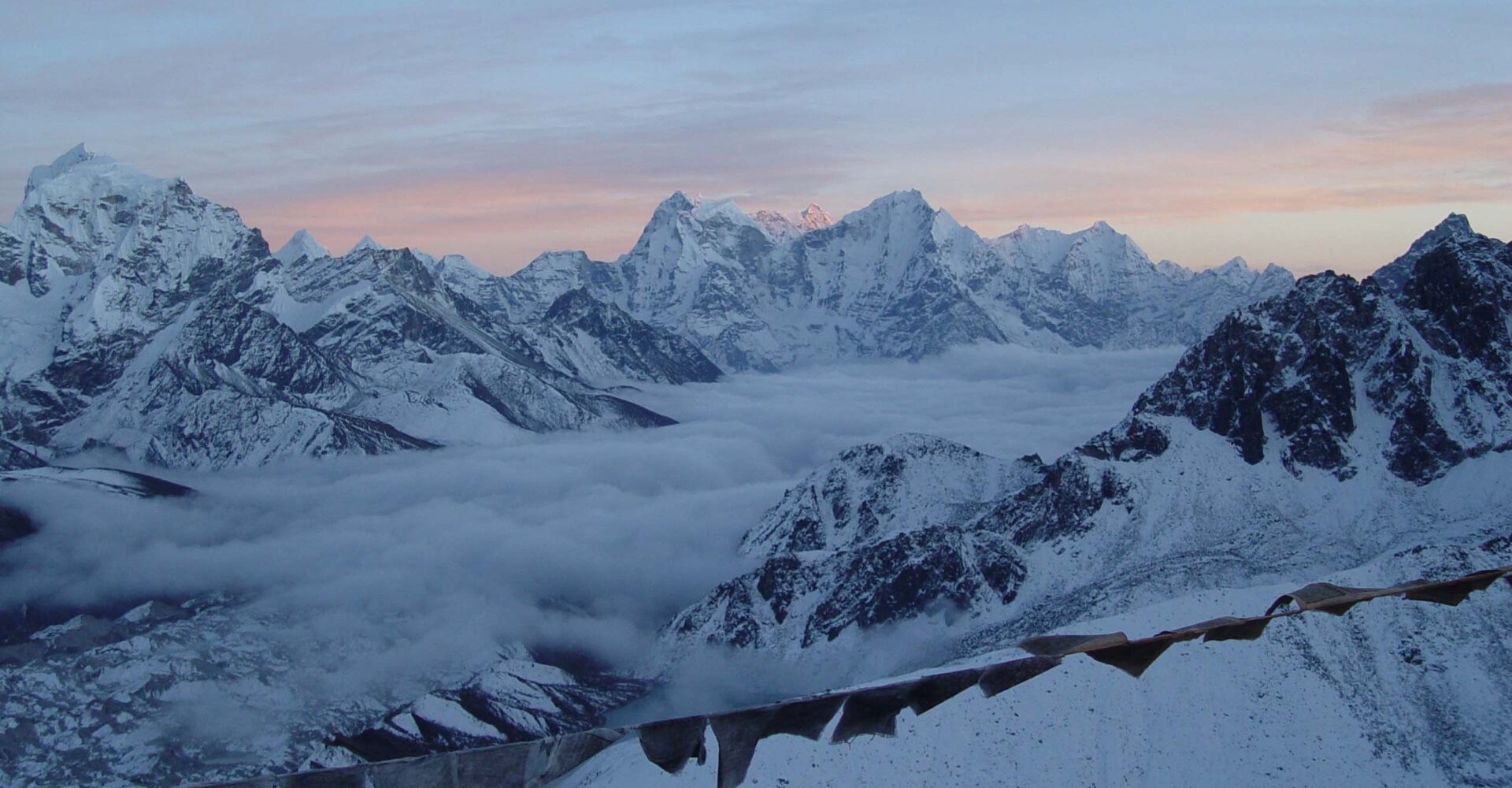
Gokyo valley trek is considered a customary trek. It offers magnificent views of the mountain peaks and the Ngo Zumpa Glacier which is the largest in Himalayas of Nepal. Mountains such as Cho Oyu, Everest, Lhotse and Makalu which are clearly visible from Gokyo Ri above Gokyo Lake. One of the most remarkable features is the panorama of the tremendous ice ridge between Cho Oyu and Gyachung (2,922 m) located in Khumbu region.
After a 35 minutes flight from Kathmandu landing at Lukla’s tiny airstrip, the adventure really begins. We spend the next few days trekking and interacting amongst the mountain people also known as Sherpa’s, we stay at local lodges and trek into the heartland of their villages.
Everything is organized in conjunction with local Sherpa guides. Along the trek, we will pass Buddhist monasteries with the views of Everest and other snow towering mountains getting closer by the day. We will have rest days in the villages of Namche bazaar that will allow us to explore the region and acclimatize, which is very important. After trekking to Gokyo Ri (5,483 m), we return at a leisurely pace back to Namche and Lukla for our flight back to Kathmandu.
Outline Itinerary
- Day-01: Arrive Kathmandu , Transfer to the Hotel.
- Day-02: Acclimatization day in Kathmandu and Sightseeing in your intended sights of Kathmandu valley.
- Day-03: Kathmandu - Salleri(2360m) drive by private Jeep and spend night.
- Day-04: Salleri – Ringmu(2730m) takes about 5 to 6 hours and spend night.
- Day-05: Ringmu – Jubhing(1680m) it takes about 5 to 6 hours and overnight.
- Day-06: Jubhing - Bupsa(2340m) takes about 4 to 5 hours.
- Day-07: Bupsa – Paiya(2730m) and takes about 6 hours.
- Day-08: Paiya – Surke(2290m) it is almost all the way gradual and down to the River and can’t enjoy a lot because of down Hill passes.
- Day-09: Surke – Phakding(2736m) takes about 6 hours and spend night.
- Day-10: Phakding - Namche Bazar (3446m) - 6½ hours.
- Day-11: Namche Bazar, one-day rest for acclimatization.
- Day-12: Namche Bazar – Dole(4200m) takes about 5 to 6 hours and spend overnight.
- Day-13: Dole – Phanga(4450m) takes about 5 hours and spend overnight.
- Day-14: Phanga – Gokyo(4790m) takes about 3 to 4 hours.
- Day-15: Gokyo – Dole(4200m) it takes about 5 to 6 hours because of all the way down.
- Day-16: Dole – Namche – 4 to 5 hrs.
- Day-17: Namche –Lukal – 6 hours.
- Day-18: Lukla – Kathmandu 30 minutes flight by domestic Airline and settle your night at Kathmandu Hotel.
- Pair trekking boots and waterproof
- Pair lightweight trekking sandals
- Pairs thin walking socks
- Pairs lightweight trekking trousers must be windproof as well.
- Pair shorts
- Trekking shirts
- Fleece jumper
- Wind stopper
- Set lightweight thermals
- Down body warmer
- North Face Waterproof Jacket (Preferably)
- North Face Waterproof trousers (Preferably)
- Four seasons down jacket ( Can be rented in Kathmandu )
- Hat with ear covers
- Neck warmer
- Pairs ‘thinners’ gloves
- Rucksack with hydration kit and belt bag
- Personal wash kit (include fabric washing solution)
- Leki Pole (Preferably)
- Pack tissues and wet wipes and liquid detergent
- Pair sunglasses
- Camera and films
- Head torch and spare batteries
- The sleeping bag can be -20 (4 seasons)
Above things are required for the normal trekker and if you have yourselves, you can bring and if do not have and want to buy and hire in Nepal, we have every equipment cheaper price than your country.
- Arrival transfer to hotel,
- Sightseeing in different ancient cities in Kathmandu by car.
We explore the Kathmandu valley by taking a guided look around Swayambhunath, the monkey temple, with its commanding views of Kathmandu, huge Stupas and synthesis of religions. We also visit the Hindu Pashupatinath on the banks of the holy Bagmati River with its saddhus and temple complex, and the huge stupa at Boudhanath which is surrounded by a lively Tibetan community with traditional Gompas and monasteries. In the late afternoon, we can sort out any equipment that you need to rent. During your staying in Nepal you can have chances to see many Hindus or Buddhist Temple around you with the local devotees on the in worshiping many gods and goddess.
Flight booking conditions:
Nepal 's Domestic airlines are always tight in major tourist destinations like Lukla, Jomsom, Phaplu, Dolpa and Jumla in peak tourist seasons. The passengers start to book their flight from June July, august for the autumn season treks, We feel sorry for your inconvenience, there is not any facilities to book the domestic flight from your home country except Royal Nepal Airlines just for Pokhara either, because most of the domestic airlines are operated by private sector who still do not have International flight connection due to the lack of agro plane. So that you have to book your flight through Travel Agency located in Nepal or by we kind of Trekking Crews. Any way I will book your flight as soon as you give me confirmation of your trip with me.
Accommodation in hotel lodges
Nepal 's Accommodation in Trekking areas are slowly moving to mini urbanization process. Wherever you go, the National Parks and Conservation Projects are working to enhance the living standard comparing to the clean and hygienic society. So everywhere you will see breaking the rocks to build the new buildings and cemented to make clean. You will find cottage types of lodges with separate and dormitory beds rooms in every shelters with improving toilets, hot shower and sun room with clean and wooden dinning table with the big metal chimney on the middle of Dinning Room to have the fire while in the evening burning fallen woods below 3500m. and the Yak Dung over 3500m.
There have been many changes along popular trekking routes over the past few years, especially since the barrage of bestsellers about the 1996 Everest drama, which caused a renewed interest especially in the Solu Khumbu region. Since then many new lodges have been built along all trekking paths, offering a variety of amenities.
Generally, the lodges in the trekking region are more basic. Rooms tend to be small, unheated wooden boxes with two beds, and only the more upscale versions offer electric lights fed by solar panels. Toilets are often squat-style wooden outhouses. Toilet paper is available for purchase everywhere.
-3 times meals BF, LN, DN in same lodges everyday.
All our meals will be at teahouses and, although the food is usually plentiful and delicious, you should be aware that the menu is not normally extensive.
However, the menus in all lodges offer a surprising variety of foods. Most lodge owners have learned about western food preferences and offer items such as pizza, lasagna, muesli, sandwiches and even burgers. If you wish, we provide you with an opportunity to watch a lodge kitchen in action, producing an enormous number and variety of meals on a single wood-burning stove. You will definitely gain an appreciation for the effort that goes into satisfying the appetites of tourists from all over the world. But keep in mind that a lot of the ingredients for such "exotic" foods have to be carried on porters’ backs, and the further you get from original food supplies, the higher the price tag will be on some of these items.
We, Nepalese eat a meal of Dhal Bhaat (rice with lentil soup, curry and pickles) twice daily. The ingredients vary according to local and seasonal availability, but vegetarian options are the norm. Another cheap popular local dish is the ubiquitous instant noodle soup, enhanced by local vegetables, or meat or egg, depending on availability. Eating Nepali-style will provide you with a truly local experience, guarantees fresh ingredients everywhere, and rules out disappointments. Let’s face it: Lasagna Himalaya-style will not be the true Italian version you may be accustomed to.
The Kitchens staffs you will find are trained for cooking, and guest relation, The foods will be served with according to the Lodge Management Committee approved Menu system providing Nepalese, Indian, Chinese and Continental western foods. Beers, Whisky western and Nepalese, Snickers, Mar Bars, Coca Cola, Mineral water, Cereals and many others essentials foods will be available in every lodges. And do not forget of Garlic and RARA noodles soups will make you smelly going up to avoid by high altitude sickness. For a quick fix: Tea is available everywhere and Nepali biscuits are cheap, delicious and provide a great energy boost for long uphill climbs.
Most teahouses offer a variety of rice and noodle dishes, as well as soup and seasonal vegetables. A variety of cereals, bread and egg dishes are generally available for breakfast. There will also be plenty of snacks available such as biscuits, chocolate and soft drinks and in some areas, you will find fresh fruit in season.
Staffs (Guides and Porter number of necessary)
Normally, I use to organize Trekking trips as package base for everyone in Nepal Himalayas. It means, they are free from all kinds of dealing for the costs every day. They can explore with beautiful sceneries of Himalayas and natures every day with flexible itineraries & dynamic services.
So many my previous clients they were so satisfied and enjoyed a lot with our Guiding performance and all kinds of logistic services during those trips. So, I am sending you my very reasonable package cost with some more options. I hope, you will understand we are working crews ourselves and we don’t need to pay commission and your payments goes direct we kind of Guides and Porters.
This is fairly demanding trek and so you should be reasonably fit, or know that you can get fit quickly. It isn't possible nor necessary to get truly trekking fit before the trek. I trek a daily itinerary that suits loaded porter, who carrying 20 kg loads cover more distance that you might think, but not so much so as to finish you. Over the course of the first week you'll be amazed at how your fitness improves. You can even get exercise in your city before you come; swimming, small day hiking and physical fitness may help you to hike in Nepal Himalaya.
When trekking or climbing above 3000m/10,000ft it is important to take into account the effect of altitude on your body. The thinner air affects you in many ways and if you go high too fast you can kill yourself as we have seen on this year one of 53 years old Indian and 57 years Russian citizens from Pune and Moscow died suddenly in Namche as soon as they arrived.
Commonly called altitude sickness, this has the potential to affect all trekkers from 2500m and higher. Your body needs time to adjust to smaller quantities of oxygen in the air - at 5500m/18,044ft the air pressure is approximately half that of sea level, ie there is half the amount of oxygen (and nitrogen). This is approximately equivalent to the top of Gokyo Ri and Kalapather, in the Everest region.
For treks below an altitude of about 3000m/10,000ft, it is not normally a problem. AMS is caused by going up high too fast and can be fatal if all the warning signals are ignored. Note that it is not the actual altitude, but the speed at which you reach higher altitudes which causes the problems.
Altitude sickness is preventable. Go up slowly, giving your body enough time to adjust. These are the 'safe' rates for the majority of trekkers: spend 2-3 nights between 2000m/6562ft and 3000m/10,000ft before going higher. From 3000m sleep an average of 300m/1000ft higher each night with a rest day every 900-1000m/3000ft. ultimately it is up to you to recognize the symptoms, and only ascend if you are relatively symptom-free.
I trek with limited distance every day so that my every client can take advantage of being in the Himalaya, However, Some time suddenly or Just in case of your usual disease or other accidental causes may need you to get rescued from Himalaya.
So at that duration you will be fully responsible to pay the Helicopter charges as soon as you arrive in Kathmandu by yourself or asking amount from your home country or with the response from related Embassy in Kathmandu, which will be paid back by your Insurance company in your country after claiming your paid in Nepal amount with the help of Doctors certificates, Airlines Certificates and other documents given from authorized Person like Guide, Local Govt. Member or People of related fields where you get sick.
We are the authorized Trekking Guides and Porters Cooperative only one trekking company in Nepal which is registered in Nepal Government company, Nepal Tourism board and every single affiliate companies of Nepal trekking.
Straight, Up the hill, Downhill, Jig Jag with small rocky, pebbles, muddy, somewhere dusty, man-made stone steps, through the moss covered forests, Rocky glacier or If snows, snowy path crossing suspensions metal bridges and wooden bridges over the rivers and streams are the main features of Trekking trials of Nepal.
So You should be mentally prepared to spread over your foot on this land. Do not need to be the worry, if you have already physical exercises and practices to the hiking would be easy. We have acclimatized days and it makes you so comfortable to do Nepal trek.
Just in Lukla, Phakding, Namche Bazar,Thame, Khumjung , Tengboche and Pangboche does have hydro -electricity, You can recharge your camera batteries just in those places. After that level you will need to sleep with candles and Solar battery lights just in the Dining Room during the dinner time and you can not recharge the batteries.
However Nepal is second richest in the world for water after Brazil, The water here is just 0.3% of total water is pure. Because most of the rivers flow from the glacier and from top to bottom and hilly mountains. As you know people live on the mountain and the animals graze in the pastures and most of the manual flows together.
On the other hand, you can buy the mineral water bottle but we feel very sorry to discourage you from not to buy, considering our Environment. But there is an idea, We can purify the water using some Iodine Pills or Purifying drops which can be available in drug stores in Kathmandu. We can use the water after nearly boiled which is safe.
You can call or email at your home or friends from most of the times by now. Those destinations have telephone facilities for the moment.
However, you have chances to send and receive e-mail from most of the places. Here are several internet cafe facilities via satellite and quite fast by now. So you do not need to worry about a communication gap with your family or friends during your trek.
We do our life insurance and Trekking insurance for the duration of 10 or 15 years from the reputed insurance company in Kathmandu, Nepal which covers our insurance for the duration of our trek as well.
Well, I hope above details will be quite enough for you to understand for your upcoming trip to Nepal Trekking. If you agree with my proposal please do let me know your opinion. Please do feel free to contact me if you have found any error in my sending.
Do not hesitate to ask me any question; I am here ready to answer your specific questions. I hope you will give me the opportunity to work with you if I am Lucky. I will be waiting for your reply. Please do feel free to ask me if you have found any error in my sending.


