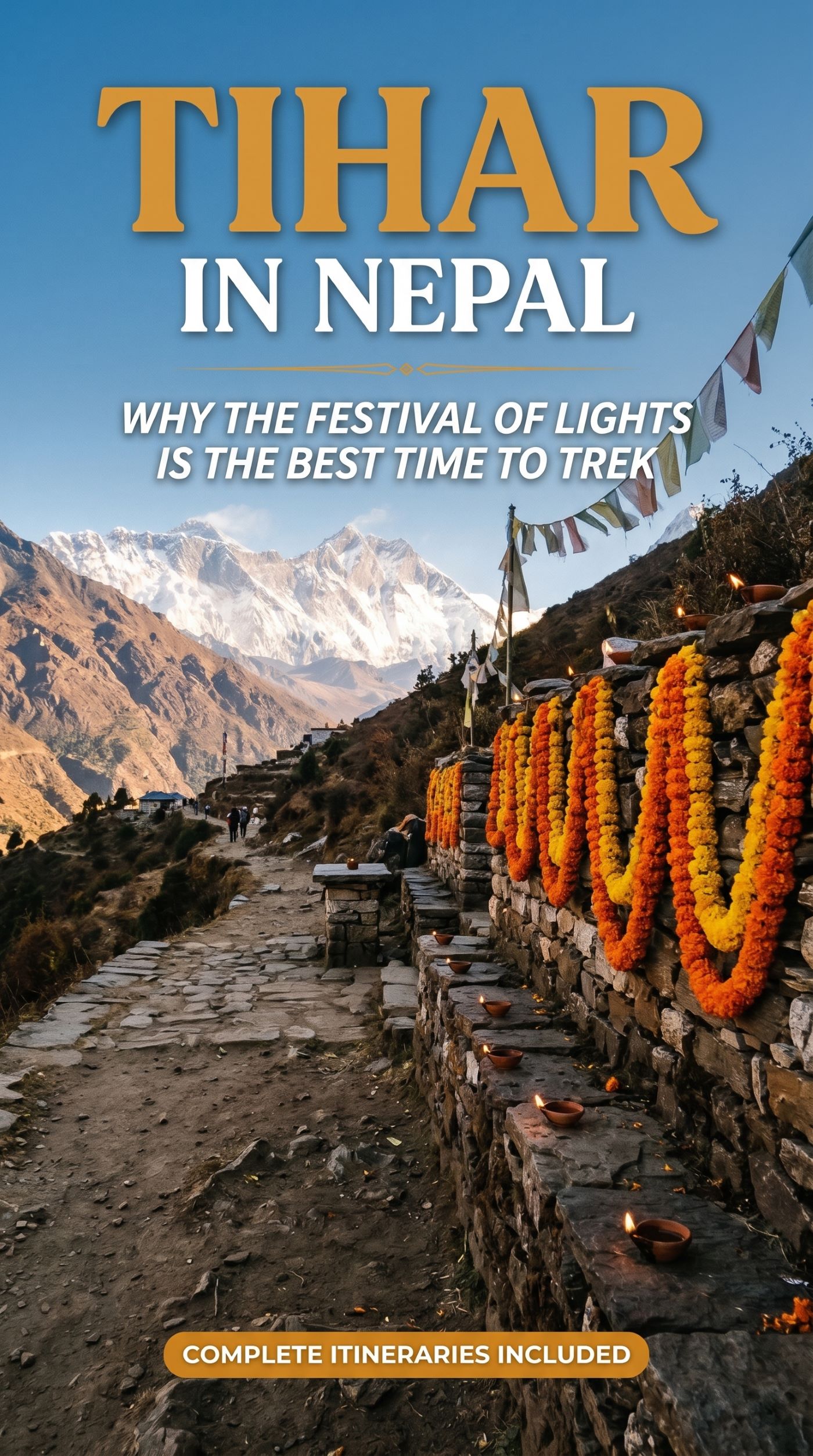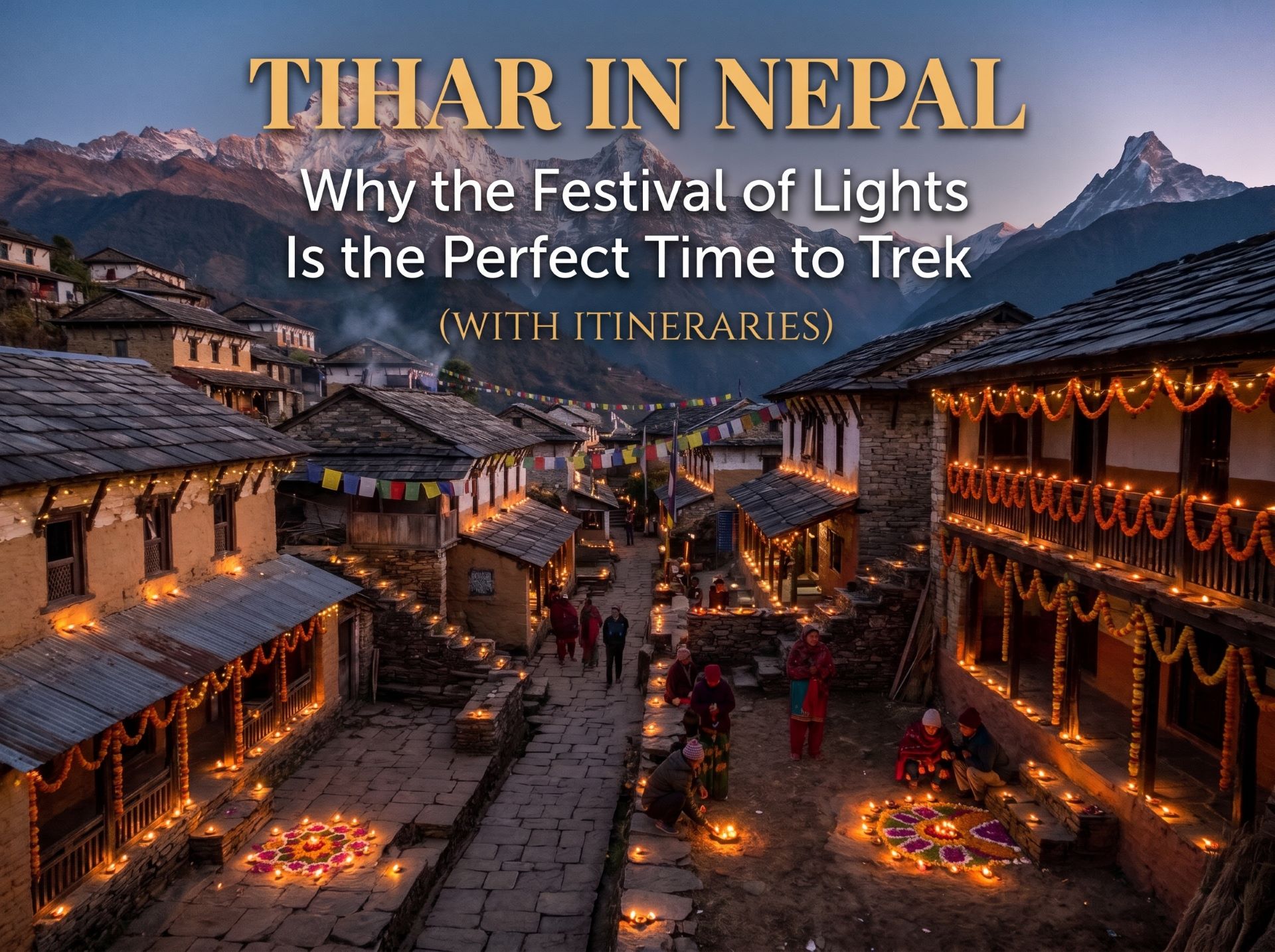
Most trekkers aim for October’s clear skies and head home before November. They’re missing something extraordinary. Tihar in Nepal—the five-day festival of light Nepal celebrates with oil lamps, marigold garlands, and door-to-door singing groups—transforms Kathmandu Valley into a living canvas of lights and devotion. And the best part? The trekking trails remain pristine, the crowds thin out after Dashain, and you can finish your Himalayan adventure just in time to experience Bhai Tika Nepal with a local family.
This guide covers the trekking season during Tihar, the best routes to pair with the festival, and a sample itinerary that puts you on the trail first and in the heart of the celebrations second.
Part 1: Understanding Tihar & Its Trekking Season
What Is Tihar?
Tihar (also called Deepawali or Diwali in Nepal) is a five-day Hindu festival observed in the Nepali month of Kartik (October–November). Unlike India’s Diwali, Nepal’s Tihar has a distinctly local rhythm: it honors animals, the goddess Laxmi, and the bond between siblings. As reported by The Independent, the five-day festival begins with worshipping crows, followed by dogs, then cows, with the final day dedicated to sisters praying for their brothers’ well-being.
| Day | Name | What Happens |
|---|---|---|
| Day 1 | Kaag Tihar | Crows are worshipped with food offerings |
| Day 2/3 | Kukur Tihar (Nepal Dog Festival) | Dogs receive marigold garlands, tika, and special treats for their loyalty |
| Day 3/4 | Gai Tihar & Laxmi Puja | Cows are honored; homes are lit with oil lamps to welcome the goddess of wealth |
| Day 4 | Goru Puja / Mha Puja | Oxen are worshipped; Newari New Year celebrations |
| Day 5 | Bhai Tika | Sisters apply seven-colored tika to brothers’ foreheads and pray for their long life |
2026 Dates: Tihar begins November 7, with Bhai Tika falling on November 10. Diwali/Laxmi Puja is observed November 8.
Trekking Conditions During Tihar (Early–Mid November)
| Factor | Condition | Verdict |
|---|---|---|
| Weather | Post-monsoon stability; clear skies, dry trails | Excellent |
| Temperature | Daytime 5–15°C at altitude; nights cold but manageable | Good |
| Crowds | Thinner than October peak; Dashain crowds have departed | Moderate |
| Teahouse Availability | Plentiful; no October-style booking stress | Easy |
| Festival Atmosphere | Villages celebrate Tihar; you may be invited to join | Unforgettable |
Key insight: November is widely considered the single best trekking month in Nepal. Skies are clear, trails are dry, and visibility is excellent. According to Weather Spark’s historical data for Kathmandu, November 5 is statistically the clearest day of the year, with 93% of the time either clear or mostly clear. Tihar falls right in this sweet spot. For a full overview of Nepal’s festival calendar, see festivals in Nepal.
Part 2: Best Treks to Pair with Tihar
Quick Comparison Table
| Trek | Duration | Difficulty | Why It Works for Tihar |
|---|---|---|---|
| Ghorepani Poon Hill | 5–7 days | Easy–Moderate | Finish in Pokhara; easy transport back to Kathmandu for Bhai Tika |
| Everest View Trek | 7 days | Easy–Moderate | Short, low-altitude, stunning views without EBC commitment |
| Langtang Trek | 10 days | Moderate | Close to Kathmandu; Tamang villages celebrate Tihar richly |
| Everest Base Camp | 12–16 days | Challenging | For serious trekkers; finish just before Bhai Tika |
| Annapurna Circuit (short) | 15 days | Moderate–Strenuous | Complete before Tihar or extend into it |
1. Ghorepani Poon Hill Trek (5–7 Days) — Best for Festival Timing
The classic short trek: maximum reward for minimum days. You’ll reach Poon Hill (3,210m) for sunrise over Annapurna and Dhaulagiri, then descend to Pokhara with time to spare. From Pokhara, a tourist bus or flight gets you to Kathmandu for Bhai Tika.
Why it fits Tihar: You can start the trek around November 1–3, finish by November 8–9, and be in Kathmandu for Laxmi Puja and Bhai Tika. See Ghorepani Poon Hill Trek.
2. Everest View Trek (7 Days) — The Short Everest Experience
If you want Everest views without the altitude and time commitment of Base Camp, this is your route. The trek typically flies to Lukla, reaches Namche Bazaar, and hikes to Everest View Hotel (3,880m) for panoramic Himalayan vistas.
Why it fits Tihar: Seven days is manageable within the festival window. Return to Kathmandu by November 9 for the main Tihar celebrations. See Everest View Trek 7 Days.
3. Langtang Trek (10 Days) — Culture + Mountains
Langtang is Kathmandu’s closest major trekking region—a 6–8 hour drive to Syabru Bensi. The valley is home to Tamang and Tibetan communities whose stone houses and monasteries offer a deeply cultural experience.
Why it fits Tihar: The Tamang people celebrate Tihar (though their Sonam Lhosar is the bigger event). You’ll experience festival traditions in a mountain village setting—far from tourist crowds. See Langtang Trek.
4. Everest Base Camp (12–16 Days) — For the Committed
The iconic trek. If EBC is your priority, you need to start before Tihar (late October) to finish by early November. Alternatively, start after Bhai Tika (November 11+) and trek into late November, when conditions remain excellent.
Why it fits Tihar: Tight but doable if you plan around the festival. You’ll miss the Kathmandu celebrations but may encounter Tihar rituals in Namche or Tengboche. See Everest Base Camp Trek.
5. Annapurna Trekking (Short Circuit, 15 Days)
The 15-day Annapurna Circuit crosses Thorong La (5,416m) and finishes at Jomsom. It’s a serious commitment but rewards with some of Nepal’s most dramatic scenery.
Why it fits Tihar: You’d need to start in late October to finish before Bhai Tika, or accept celebrating Tihar on the trail. See Annapurna Trekking.
Part 3: Sample Itinerary — Poon Hill Trek + Tihar in Kathmandu
This 10-day itinerary puts you on the trail first, then delivers you to Kathmandu for the festival’s most important days.
| Day | Date (2026) | Activity | Location |
|---|---|---|---|
| 1 | Nov 1 | Arrive Kathmandu; trek briefing | Kathmandu |
| 2 | Nov 2 | Fly/drive to Pokhara; drive to Nayapul; trek to Hile | Hile |
| 3 | Nov 3 | Trek to Ghorepani | Ghorepani |
| 4 | Nov 4 | Sunrise at Poon Hill; trek down; drive to Pokhara | Pokhara |
| 5 | Nov 5 | Buffer day / explore Pokhara | Pokhara |
| 6 | Nov 6 | Drive/fly to Kathmandu | Kathmandu |
| 7 | Nov 7 | Kaag Tihar — explore Kathmandu; observe crow rituals | Kathmandu |
| 8 | Nov 8 | Kukur Tihar & Laxmi Puja — witness the Nepal dog festival; evening lights | Kathmandu |
| 9 | Nov 9 | Explore Patan/Bhaktapur; Tihar decorations | Kathmandu Valley |
| 10 | Nov 10 | Bhai Tika — witness or participate in sibling rituals; farewell dinner | Kathmandu |
Why this works: You get five days of trekking (including Poon Hill sunrise), a buffer day for weather delays, and four full days immersed in Tihar’s most visually stunning rituals. The Nepal dog festival (Kukur Tihar) on November 8 is a photographer’s dream—as The Independent’s coverage of Kukur Puja shows, dogs across Nepal receive garlands, vermillion marks, and treats in a celebration that honors their role as messengers of Yamraj, the god of death.
Part 4: What to Expect During Tihar on the Trail vs. in the City
| Aspect | On the Trail | In Kathmandu |
|---|---|---|
| Atmosphere | Quieter; villages celebrate modestly | Explosive color, lights, music |
| Kukur Tihar | May see dogs honored in villages | City-wide celebrations, organized events |
| Laxmi Puja | Simple lamps in teahouses | Entire city lit with oil lamps and electric lights |
| Bhai Tika | Rare to witness unless invited | Ubiquitous; every family celebrates |
| Crowds | Minimal | Heavy in tourist areas |
| Photography | Mountain landscapes | Cultural rituals, street scenes |
Pro tip: If you want to experience Bhai Tika Nepal authentically, ask your trekking agency if they can arrange a homestay or family invitation. Many local agencies have connections with Kathmandu families who welcome respectful guests for the ritual.
Part 5: Practical Tips for Tihar Trekking
Booking & Logistics
- Book teahouses in advance only for EBC; other routes have ample availability in November.
- Domestic flights (Pokhara–Kathmandu, Lukla) can be disrupted by festival demand. Book early.
- Buses fill up as Nepalis travel home for Tihar. Reserve tourist bus tickets 3–5 days ahead.
Travel Insurance (Critical for Trekking)
Tihar falls in November, which means cold nights at altitude and the usual trekking risks. Do not skip insurance. According to World Nomads’ guide to trekking insurance in Nepal, helicopter evacuation is included as part of medical transport cover—but you must contact their 24/7 emergency team yourself, because Nepal has seen scams where guides falsely claim insurance authorization. Also note: World Nomads’ hiking coverage page specifies that you must select your maximum altitude when buying the policy (e.g., up to 4,500m or 6,000m), and you cannot add activities after purchase.
Key takeaway: Buy insurance that explicitly covers trekking to your planned altitude (EBC reaches 5,364m; Thorong La is 5,416m), and carry the emergency contact number with you.
What to Pack (Festival Edition)
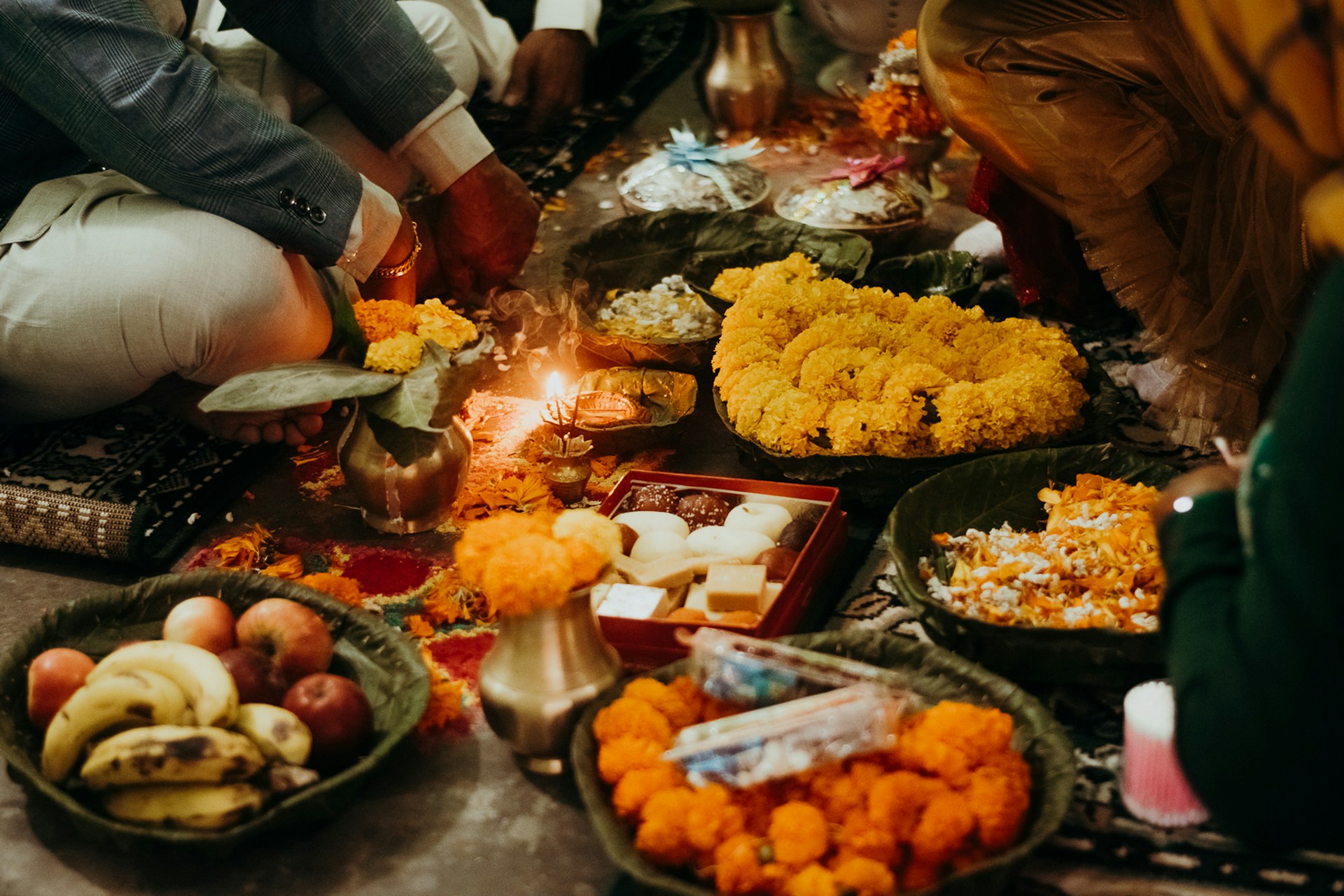
- Nice clothes for Bhai Tika if you’ll be in Kathmandu (you may be invited to a family celebration)
- Small gifts (sweets, fruit) if you’re invited to a Tihar meal
- Camera with good low-light capability for Laxmi Puja evening shots
- Standard trekking gear (layers, down jacket, trekking poles)
Cultural Etiquette
- Accept tika if offered. It’s a blessing, not a performance.
- Don’t photograph Kukur Tihar dogs without asking if they’re with owners.
- Bhai Tika is family-focused. If invited, bring a small gift and dress respectfully.
Conclusion: The Festival + Mountains Combo Nobody Talks About
Tihar is Nepal’s most visually spectacular festival—a five-day celebration of animals, light, and family bonds. November is Nepal’s most reliable trekking month. Pairing them isn’t just possible; it’s arguably the smartest way to experience both.
You’ll trek through clear-skied Himalayan foothills, descend to a city glowing with oil lamps, watch dogs receive garlands in the streets, and perhaps find yourself with a tika on your forehead and a Nepali family wishing you long life.
Ready to plan your Tihar trek? Contact us which route interests you, and we’ll build an itinerary that gets you to the mountains and back in time for the lights.