How your body learns to breathe thin air—and why patience saves lives on the Everest Base Camp trek
Why Acclimatization Is the Difference Between Success and Rescue
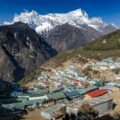
Imagine this: You’ve trained for months. You’ve flown across the world. You’re standing in Namche Bazaar, surrounded by peaks you’ve only seen in photographs. But instead of joy, you feel a throbbing headache. Your stomach churns. The thought of walking another step makes you want to collapse.
This is altitude sickness. And it doesn’t care how fit you are.
Acclimatization is the biological process that separates successful summiters from those who turn back—or worse, need helicopter evacuation . It’s not a “rest day” where you lie in bed scrolling through your phone. It’s an active, strategic process that forces your body to adapt to oxygen levels so low that sea-level dwellers would pass out .
“The mountains are not fair or unfair—they are just dangerous.” — Reinhold Messner
By the end of this guide, you’ll understand exactly what happens inside your body at altitude, how to accelerate acclimatization, and why the “climb high, sleep low” rule might save your life.
Part 1: What Actually Is Acclimatization?
The Simple Definition
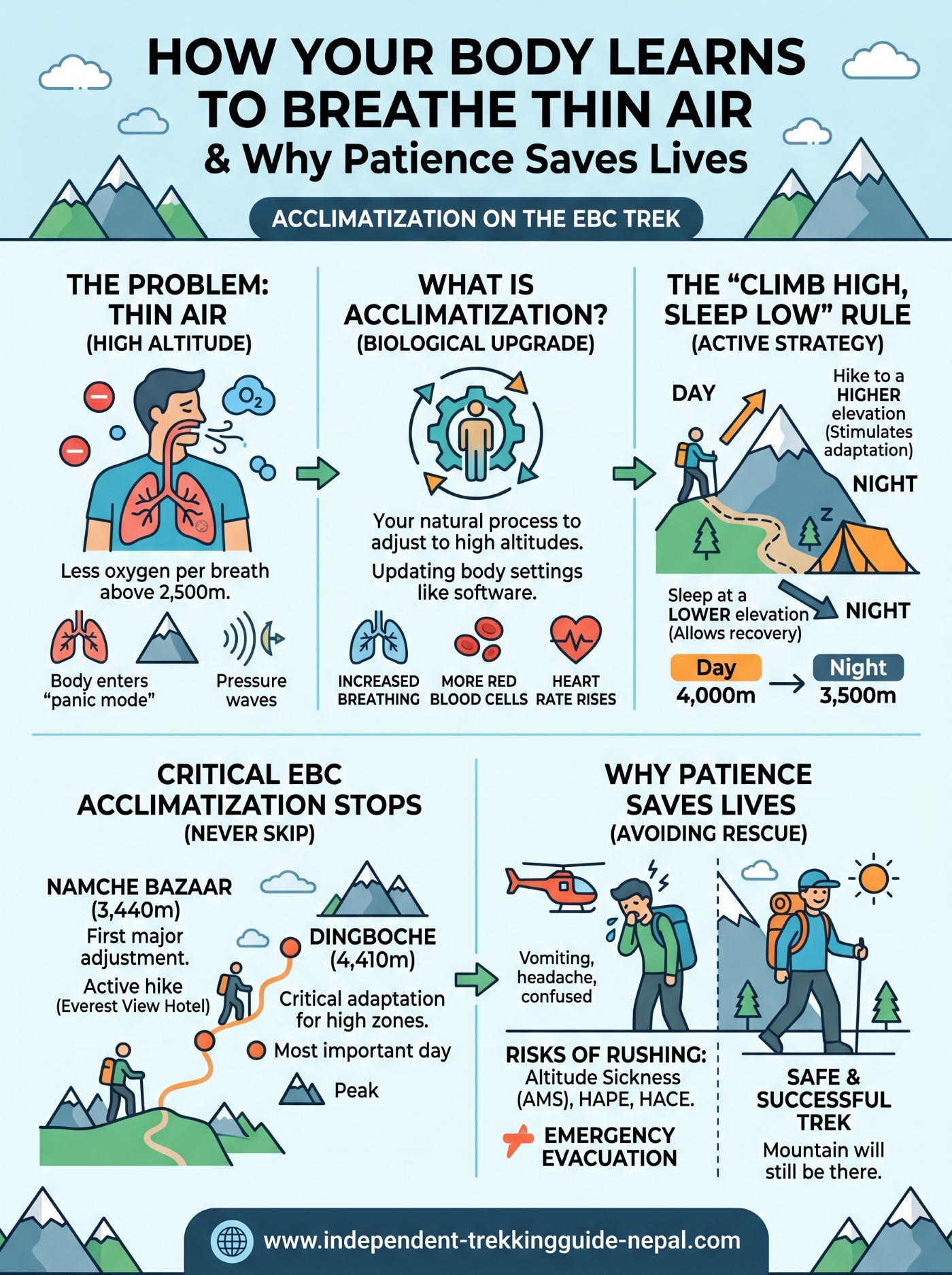
Acclimatization is the natural process by which your body adjusts to higher altitudes and lower oxygen levels . Think of it as biological software updating—your body comes pre-installed with sea-level settings, and altitude forces a rapid, uncomfortable upgrade .
What’s Happening Inside You (The Physiology)
When you ascend above 2,500 meters (8,200 feet), the barometric pressure drops. This means each breath contains fewer oxygen molecules. Your body’s immediate reaction is panic—but over hours and days, it adapts.
According to recent physiological research published in Physiological Reports, the body undergoes several measurable changes within the first 60 hours at altitude :
| Time at Altitude | Physiological Change | What You Feel |
|---|---|---|
| First hours | Increased breathing rate (hypoxic ventilatory response) | Shortness of breath, frequent yawning |
| 12-24 hours | Heart rate increases by 15-30 bpm | Feeling your pulse in your ears, palpitations |
| 24-48 hours | Body begins producing more red blood cells | Fatigue, possible headache |
| 48-72 hours | Kidneys excrete bicarbonate to adjust blood pH | Increased urination (this is good!) |
| 3-7 days | Ventilatory response stabilizes; oxygen saturation improves | Feeling “normal” at altitude |
Full acclimatization generally requires 7-10 days at a given altitude . But here’s the catch: on the Everest Base Camp trek, you’re constantly gaining elevation. You never get fully acclimatized to any single altitude—you’re always playing catch-up.
The “Climb High, Sleep Low” Principle
This is the single most important concept in acclimatization. It means:
- During the day: Hike to an elevation higher than where you’ll sleep
- At night: Descend (or remain at) a lower elevation to sleep
Why does this work? The daytime high altitude stimulates your body to adapt—increasing breathing rate and red blood cell production. Sleeping lower allows recovery and prevents the cumulative fatigue that leads to altitude sickness.
“During the day, you go higher, then descend again to sleep lower. This gives your body a strong stimulus without compromising recovery.”
Part 2: The EBC Acclimatization Schedule—Day by Day
On the standard Everest Base Camp trek, acclimatization is built into the itinerary at specific locations . Here’s what each stop looks like:
Overview of Acclimatization Points
| Location | Elevation | Purpose | Key Activity |
|---|---|---|---|
| Namche Bazaar | 3,440m (11,286 ft) | First major adjustment | Hike to Everest View Hotel (3,880m) |
| Dingboche | 4,410m (14,468 ft) | Critical adaptation before high zone | Hike to Nangkartshang Peak (5,100m) |
| Lobuche | 4,940m (16,207 ft) | Final prep for EBC | Hike to memorials or Lobuche East Base Camp |
Day 3: Namche Bazaar — The Gateway Acclimatization
Namche is the first time your body truly feels the thin air . At 3,440 meters, oxygen levels are roughly 67% of sea level. This is where most trekkers first notice: “Wow, climbing stairs is hard.”
What you actually do on this “rest day”:
| Activity | Duration | Elevation Gain | Why It Works |
|---|---|---|---|
| Hike to Everest View Hotel | 2-3 hours round trip | +440m (to 3,880m) | Classic “climb high, sleep low” |
| Visit Khumjung Village | 3-4 hours | +300m | Cultural immersion + gentle exercise |
| Explore Syangboche Airstrip | 1-2 hours | +200m | Short, steep climb |
| Sherpa Culture Museum | 1 hour | Minimal | Rest while learning |
The Everest View Hotel hike is the most popular—and for good reason. The trail ascends through rhododendron forests to a viewpoint at 3,880 meters, offering the first clear views of Everest, Ama Dablam, and Lhotse . You’ll spend about 20 minutes at the top, then return to Namche to sleep at 3,440 meters.
Real trekker experience:
“I thought a rest day meant sleeping in. My guide laughed. ‘Rest day means walking,’ he said. ‘Just not with your big backpack.'” — Sarah, EBC trekker, 2024
Day 6: Dingboche — The Critical Acclimatization
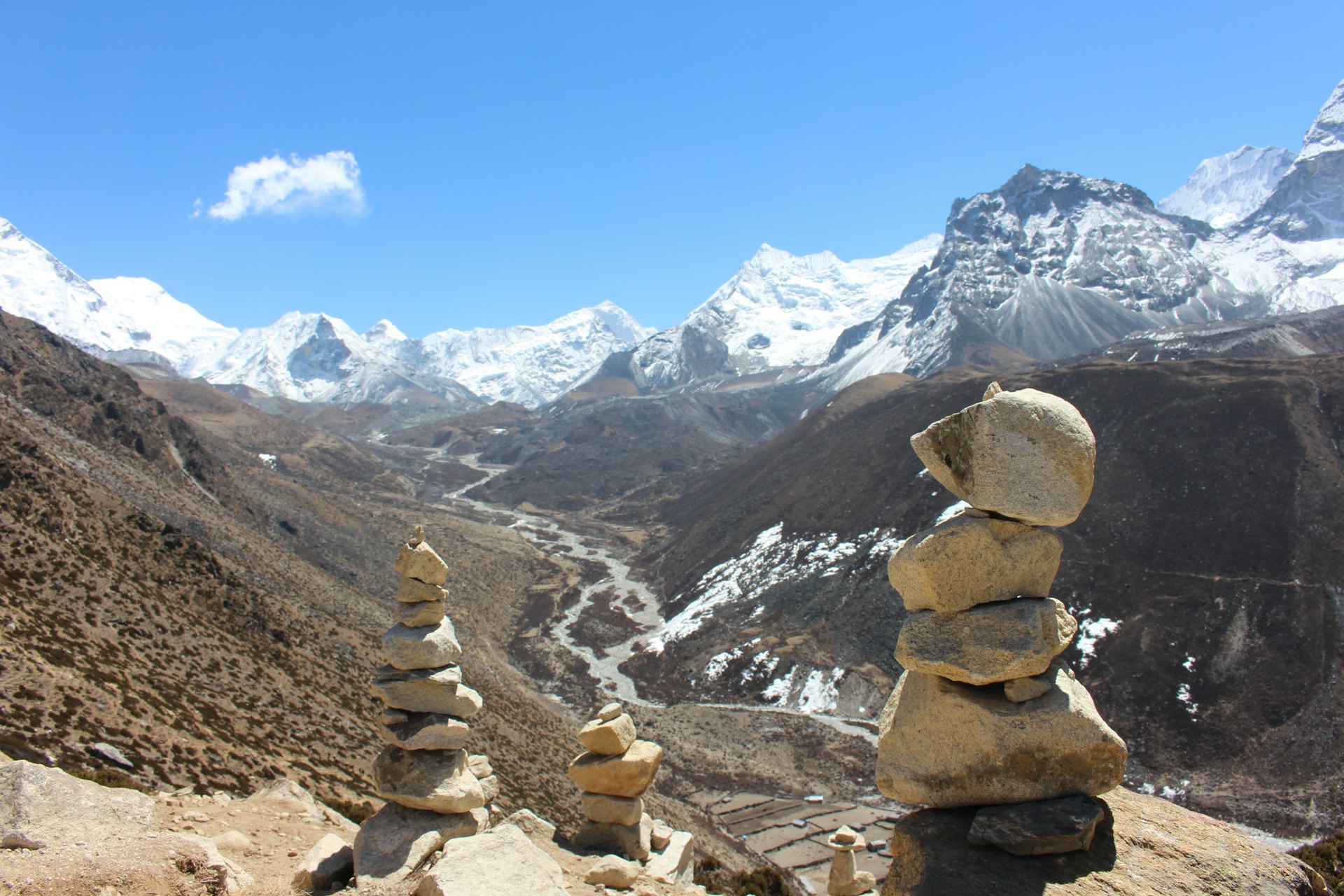
Dingboche is where the air “grows noticeably thinner, and every breath requires an extra effort” . At 4,410 meters, oxygen is about 57% of sea level. This is the most important acclimatization day of the entire trek.
What you do in Dingboche:
| Hike Option | Duration | Maximum Elevation | Difficulty |
|---|---|---|---|
| Nangkartshang Peak | 3-4 hours | ~5,100m | Strenuous but rewarding |
| Chhukung Valley | 2-3 hours | ~4,730m | Moderate, gradual |
| Ama Dablam Base Camp viewpoint | 1-2 hours | ~4,600m | Easy, well-marked |
Nangkartshang Peak is the recommended option . The 200-300 meter elevation gain provides the perfect stimulus for your body to increase red blood cell production . The views are spectacular—Ama Dablam dominates the skyline, with Lhotse and Island Peak visible in the distance.
Why this day is non-negotiable: Trekkers who skip or rush the Dingboche acclimatization day are the ones who develop severe AMS at Lobuche or Gorak Shep. Your body needs this stimulus before the push to 5,000+ meters.
Day 8: Lobuche — The Final Checkpoint
At 4,940 meters, Lobuche is where many trekkers “hit the wall.” The lodge is basic, the nights are freezing, and sleep is difficult . Your rest here is less about hiking and more about survival.
Activities at Lobuche:
- Lobuche East Base Camp hike (3 hours, ~5,200m) — for those feeling strong
- Walk to the climbers’ memorials (2 hours) — somber, humbling, and flat terrain
- Rest and rehydrate — priority for most trekkers
The memorials are a powerful reminder of the risks. Stone cairns honor climbers who died on Everest—including the famous “Green Boots” cave. It’s a moment to reflect on why acclimatization matters .
Part 3: Acute Mountain Sickness (AMS) — Recognition, Response, Rescue
What Is AMS?
Acute Mountain Sickness is the mildest form of altitude illness—but it can progress rapidly to life-threatening conditions. Symptoms typically appear 6-12 hours after arrival at a new altitude .
The AMS Self-Assessment (Lake Louise Score)
Use this simplified version to check yourself each morning and evening:
| Symptom | None (0) | Mild (1) | Moderate (2) | Severe (3) |
|---|---|---|---|---|
| Headache | None | Mild | Moderate | Severe, incapacitating |
| Nausea/Vomiting | None | Mild nausea | Moderate nausea/vomiting | Severe, constant vomiting |
| Fatigue/Weakness | None | Mild | Moderate | Severe, can’t function |
| Dizziness/Lightheaded | None | Mild | Moderate | Severe, staggering |
| Difficulty sleeping | Slept normally | Slept poorly | Woke many times | Can’t sleep at all |
Scoring:
- 3-5 with headache = Mild AMS. Rest, hydrate, don’t ascend.
- 6+ with headache = Moderate AMS. Descend 300-500m immediately.
- Any ataxia (staggering) or confusion = Severe AMS/HACE. Emergency evacuation.
The Life-Threatening Forms: HACE and HAPE
While AMS is uncomfortable, High-Altitude Cerebral Edema (HACE) and High-Altitude Pulmonary Edema (HAPE) are medical emergencies with mortality rates up to 50% without treatment .
High-Altitude Cerebral Edema (HACE)
HACE is fluid accumulation in the brain. It can occur in 0.1-2% of people above 3,000-4,000 meters .
Real case study from the Himalayas (2025):
A 47-year-old male trekker from Singapore developed mild symptoms at Dingboche (4,400m)—just a cough and mild headache. He continued to Lobuche (4,900m). Overnight, his condition deteriorated rapidly: severe headache, vomiting, confusion, and inability to walk without support. His oxygen saturation dropped to 71% .
He had isolated HACE—without preceding pulmonary edema or severe AMS.
The patient was evacuated by helicopter to Kathmandu, treated with dexamethasone and supportive care, and made a full recovery after five days .
Warning signs of HACE:
- Confusion or altered mental status
- Ataxia (staggering, inability to walk heel-to-toe)
- Severe headache unresponsive to medication
- Drowsiness progressing to unconsciousness
- Focal neurological deficits (rare)
“MRI findings revealed a focal area in the corona radiata of the right frontoparietal lobe with microbleeds—evidence of vasogenic edema. The patient had no prior risk factors.”
High-Altitude Pulmonary Edema (HAPE)
HAPE is fluid accumulation in the lungs. It can occur alone or with HACE. The 1996 Everest season saw multiple fatalities from these conditions .
Warning signs of HAPE:
- Shortness of breath at rest
- Crackling sounds in the chest
- Cough producing pink, frothy sputum
- Extreme fatigue and weakness
- Blue tinge to lips/fingers (cyanosis)
The 1996 Everest Disaster: Acclimatization Lessons
The 1996 Everest season—immortalized in Jon Krakauer’s Into Thin Air—saw 12 climbers die on the mountain. A Norwegian expedition that same season provided medical documentation of the risks .
Key findings from the 1996 Norwegian expedition’s medical report:
| Condition | Number of Cases | Outcome |
|---|---|---|
| Cerebral edema | Multiple | 4 fatal cases documented |
| Frostbite | Several | Evacuation required |
| Hypothermia | Multiple | Treated on-site |
| Exhaustion | Widespread | Assisted descent |
The report emphasized that “cerebral oedema and frostbite were the most common problems in addition to hypothermia and exhaustion” . While the expedition itself had eight of ten members summit successfully, they participated in rescuing climbers from other expeditions who were not so fortunate.
Part 4: The New Science of Acclimatization
Probiotics and Altitude: A 2025 Breakthrough
In February 2025, researchers at the NIH published a groundbreaking study on a completely unexpected tool for acclimatization: probiotics .
The study was a randomized, double-blinded, placebo-controlled trial with 17 participants. They were transported from sea level to 3,800 meters (12,470 feet) for up to four days.
Results:
| Measurement | Placebo Group | Probiotic Group | Difference |
|---|---|---|---|
| Daytime oxygen saturation (SpO2) | 86.7% | 90.2% | +3.5% |
| Nighttime oxygen saturation (SpO2) | 76.9% | 81.9% | +5.0% |
| AMS scores | Higher | Lower | Significant reduction |
The probiotic used (Oxxyslab/SLAB51) contains eight bacterial strains: Streptococcus thermophilus, Bifidobacterium animalis subsp. lactis (two strains), Lactobacillus acidophilus, L. helveticus, L. paracasei, L. plantarum, and L. brevis .
How it works: The bacteria interact with intestinal epithelial cells to stabilize hypoxia-inducible factor 1-alpha (HIF-1α)—a protein that regulates oxygen homeostasis. This may drive the intestine to use oxygen-independent metabolic pathways, reducing overall oxygen demand .
“These results suggest bacteriotherapy as a novel, non-invasive intervention for high-altitude acclimatization.”
Practical takeaway: While more research is needed, starting a high-quality probiotic weeks before your trek may improve oxygen saturation and reduce AMS symptoms.
Predictive Modeling: Can Science Predict Who Will Get Sick?
Recent research using machine learning and predictive modeling shows promise in identifying individuals susceptible to altitude illness before they ascend .
Key predictors of altitude performance include:
- Maximal oxygen pulse (VO2/HRmax) — measures cardiovascular efficiency
- Ventilatory equivalent for carbon dioxide (VE/VCO2) — indicates breathing efficiency
- Sea-level exercise test results — predict high-altitude performance loss with R² = 0.81
For trekkers: These tests aren’t commercially available yet, but they confirm what guides have long observed: how you respond to exercise at sea level is surprisingly predictive of how you’ll perform at altitude.
Part 5: Practical Acclimatization Strategies
The Golden Rules (Evidence-Based)
| Rule | Why It Works | Common Mistake |
|---|---|---|
| Ascend slowly above 3,000m | Limits hypoxic stress on organs | Gaining >500m sleeping elevation per day |
| Schedule active rest days | Stimulates adaptation without exhaustion | Bed rest (doesn’t help) or pushing too hard |
| Climb high, sleep low | Maximizes stimulus while allowing recovery | Sleeping at the highest point reached |
| Hydrate aggressively | Supports blood volume and kidney function | Relying on thirst (too late) |
| Eat carbohydrates | Carbs require less oxygen to metabolize | Skipping meals due to nausea |
| Walk at “talking pace” | Prevents overexertion and excessive ventilation | “No pain, no gain” mentality |
Hydration: How Much Is Enough?
At high altitude, you lose more water through:
- Increased breathing rate (humidifying dry air)
- Increased urination (kidneys excreting bicarbonate)
- Dry air and sun exposure
The guideline: 3-4 liters per day, minimum . Check your urine color—pale yellow is good; dark means drink more.
Nutrition: What to Eat at Altitude
| Food Type | Why It Helps | Examples |
|---|---|---|
| Complex carbohydrates | Require less oxygen to metabolize than fats/proteins | Dal Bhat (rice and lentils), pasta, potatoes, bread |
| Iron-rich foods | Supports red blood cell production | Lentils, leafy greens, eggs (if available) |
| Garlic | Traditional remedy; may improve circulation | Garlic soup (common at tea houses) |
| Warm liquids | Encourages hydration, soothes throat | Ginger tea, hot lemon, herbal tea |
The magic of Dal Bhat: This traditional Nepali meal of rice, lentil soup, and vegetables is the perfect high-altitude food. It’s carbohydrate-rich, easily digestible, and often unlimited (“Dal Bhat power, 24 hour!”).
Sleep at Altitude: Why It’s Hard and What to Do
Many trekkers struggle to sleep above 4,000 meters. This is normal—caused by periodic breathing (Cheyne-Stokes respiration) where breathing stops briefly then restarts dramatically .
Sleep tips:
- Sleep with your head elevated
- Avoid alcohol (worsens periodic breathing)
- Use earplugs (lodge walls are thin)
- Accept that poor sleep is normal and not dangerous
Part 6: Pre-Acclimatization — Can You Train at Sea Level?
The Short Answer
Partial pre-acclimatization is possible, but nothing fully replicates the real thing .
Methods of Pre-Acclimatization
| Method | Effectiveness | Availability | Cost |
|---|---|---|---|
| Altitude training camps | Moderate (2-3 week benefit) | Limited locations | High |
| Hypoxic tents/systems | Mild (sleep high, live low) | Commercial purchase/rental | Very high ($2,000+) |
| Intermittent hypoxic exposure | Mild | Specialized gyms | Moderate |
| Decompression chamber | High (but extreme) | Research only | N/A |
| High-altitude trek before EBC | Excellent | Nepal has options (e.g., Langtang) | Moderate |
The French Experiment: Mont Blanc to Everest
In 1989, a French expedition led by Eric Escoffier attempted an extreme pre-acclimatization protocol before climbing Everest’s north-northeast ridge .
Their protocol:
- One week alternating between Mont Blanc summit (4,808m) and the Vallot Observatory
- Four days in a decompression chamber at simulated altitudes of 5,000-8,000 meters
- Medical monitoring throughout
Results: They moved from Base Camp to 7,800 meters in just 9 days—an incredibly rapid ascent schedule. However, snow and wind prevented them from demonstrating the full effectiveness of their method .
For normal trekkers: This level of pre-acclimatization is impossible. The practical alternative is simple: spend a few days hiking in the Nepal hills before starting the EBC trek, or add the Langtang Valley trek as a warm-up.
Part 7: Medications and Acclimatization
Diamox (Acetazolamide)
Diamox is the most common medication for preventing and treating AMS. It is NOT a substitute for proper acclimatization—it’s a tool to help your body adapt faster.
| Aspect | Details |
|---|---|
| How it works | Makes blood more acidic, which stimulates breathing and improves oxygenation |
| Dose | 125-250mg twice daily, starting 24 hours before ascent |
| Side effects | Tingling fingers/toes, increased urination, altered taste (carbonated drinks taste flat) |
| Prescription required | Yes (see your doctor) |
Who should take Diamox:
- Trekkers with previous AMS
- Those ascending rapidly (less relevant for EBC with proper schedule)
- Anyone wanting “insurance” (discuss with your doctor)
Who should NOT take Diamox:
- People with sulfa allergies
- Pregnant women
- Those with certain kidney or liver conditions
Dexamethasone
Dexamethasone is a steroid used for treatment of severe AMS, HACE, and HAPE—not prevention . It should only be carried by guides or medically trained trekkers for emergency use.
In the 2025 HACE case report, the patient received IV dexamethasone 8mg initially, then 4mg every 6 hours .
Ibuprofen and Other Pain Relievers
Ibuprofen can mask early headache symptoms—use cautiously. Paracetamol (acetaminophen) is safer for mild headache relief as it doesn’t mask symptoms as effectively .
Part 8: Special Populations and Considerations
Age and Acclimatization
Young adults, especially males, may be at higher risk for HACE because they “tend to ascend despite experiencing symptoms of AMS” . The 2025 HACE case report noted this pattern—the patient ignored mild symptoms at Dingboche and continued ascending.
Advice: Listen to your body regardless of age. Overconfidence is dangerous.
Pre-existing Conditions
Certain conditions increase HACE risk:
- Pre-existing elevated intracranial pressure
- Vascular malformations
- Multiple sclerosis
- Cerebral venous thrombosis
- Intracranial space-occupying lesions
If you have any neurological condition, consult a high-altitude medicine specialist before trekking.
Women and Acclimatization
Research shows no significant sex-based differences in acclimatization capacity. However, pregnancy is an absolute contraindication for high-altitude trekking above 3,500m.
Part 9: Decision Points—When to Turn Back
The “Red Flag” Symptoms
| Symptom | Action |
|---|---|
| Headache not responding to medication + any other symptom | Do NOT ascend |
| Vomiting | Descend 300-500m immediately |
| Ataxia (staggering, unable to walk straight) | Emergency descent + evacuation |
| Confusion or altered mental status | Emergency descent + evacuation |
| Shortness of breath at rest | Emergency descent + evacuation |
| Crackles in chest | Emergency descent + evacuation |
Real Decision Points from the Trail
The Dingboche test: If you wake up in Dingboche with a severe headache and vomiting, you should not proceed to Lobuche. Descend to Pangboche or lower. Many trekkers have saved their own lives by making this choice.
The Lobuche crossroads: If you reach Lobuche and cannot sleep, have persistent headache, or feel “off,” consider whether pushing to EBC is worth the risk. The mountain will still be there next year.
“You are not defeated when you turn back. You are defeated when you ignore your body and continue.” — Sherpa guide, quoted in multiple EBC forums
Part 10: Summary Checklist for EBC Trekkers
Before You Go (Preparation)
- Schedule at least 12 days for the trek (14-16 is better)
- Consult your doctor about Diamox
- Consider starting probiotics 4-6 weeks before
- Read “Into Thin Air” (motivation AND warning)
- Book with an operator that includes both Namche and Dingboche acclimatization days
- Purchase comprehensive evacuation insurance
During the Trek (Daily)
- Wake up and self-assess for AMS symptoms
- Drink 3-4 liters of water (carry a reusable bottle + purification)
- Eat carbohydrates at every meal (Dal Bhat power!)
- Walk at “talking pace”—never out of breath
- On acclimatization days: HIKE UP, don’t rest in bed
- Sleep with head elevated
- NO alcohol (seriously—it worsens AMS and dehydration)
- Track your sleeping elevation (no more than 300-500m gain per day above 3,000m)
Emergency Response
- Know your guide’s emergency contact protocol
- Carry a copy of your insurance and emergency contacts
- If in doubt about symptoms: DESCEND
- If severe symptoms: DESCEND + CALL FOR HELICOPTER EVACUATION (insurance should cover)
Conclusion: Respect the Mountain, Listen to Your Body
Acclimatization is not a suggestion—it’s the only thing standing between you and a life-threatening emergency at high altitude. The mountains don’t care about your bucket list, your training regimen, or your budget. They care only about physiology.
The good news is that thousands of trekkers reach Everest Base Camp every year by following the simple principles in this guide: ascend slowly, climb high and sleep low, hydrate, eat carbohydrates, and—most importantly—listen to your body when it says “stop.”
“It’s not the mountain we conquer, but ourselves.” — Sir Edmund Hillary
The mountain will be there next year, and the year after. Your health won’t wait. Trek smart, trek safe, and earn every step to the foot of the world’s highest peak.
Additional Resources
| Resource | Link/Description |
|---|---|
| International Society for Mountain Medicine | www.ismm.org — Research and guidelines |
| Himalayan Rescue Association | Clinics in Pheriche and Manang |
| Medex Altitude Tutorial | Free online course on altitude illness |
| Lake Louise AMS Score (Official) | Downloadable self-assessment card |
Have you experienced altitude sickness on a trek? Or do you have questions about preparing for the EBC trek? Share your story in the comments below—your experience could help another trekker stay safe on the trail.