The image of a solitary climber standing on the roof of the world is iconic. The modern reality, often captured in viral photos of a “traffic jam” at the summit ridge, is strikingly different. So, just how many people climb Mount Everest each year, and what does this number tell us about the evolution of the world’s ultimate adventure?
By the Numbers: The Annual Ascent
The short answer is: A record-breaking number, but still a tiny fraction of those who attempt it.
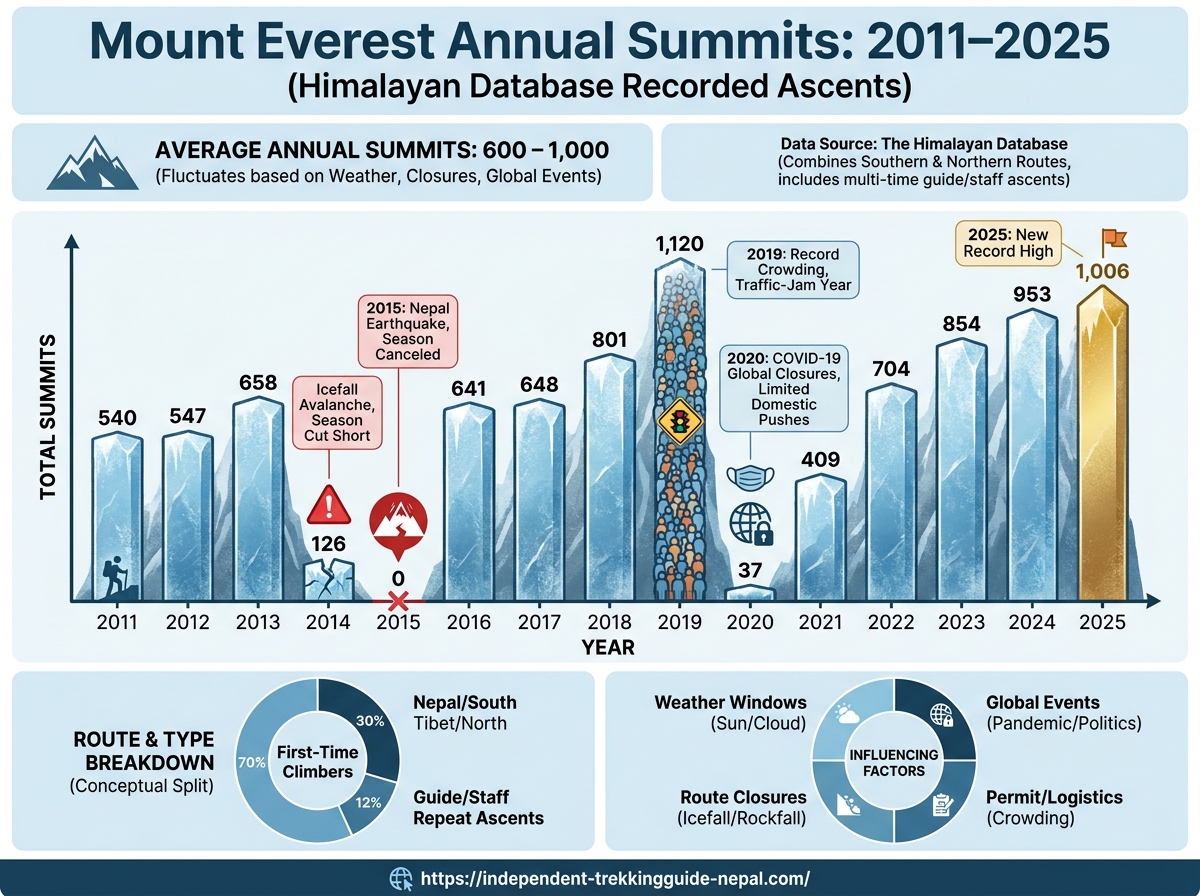
Since Sir Edmund Hillary and Tenzing Norgay’s first ascent in 1953, over 6,600 different people have reached the summit as of the end of 2023. However, the annual figures have surged dramatically in the 21st century, particularly in the last 15 years.
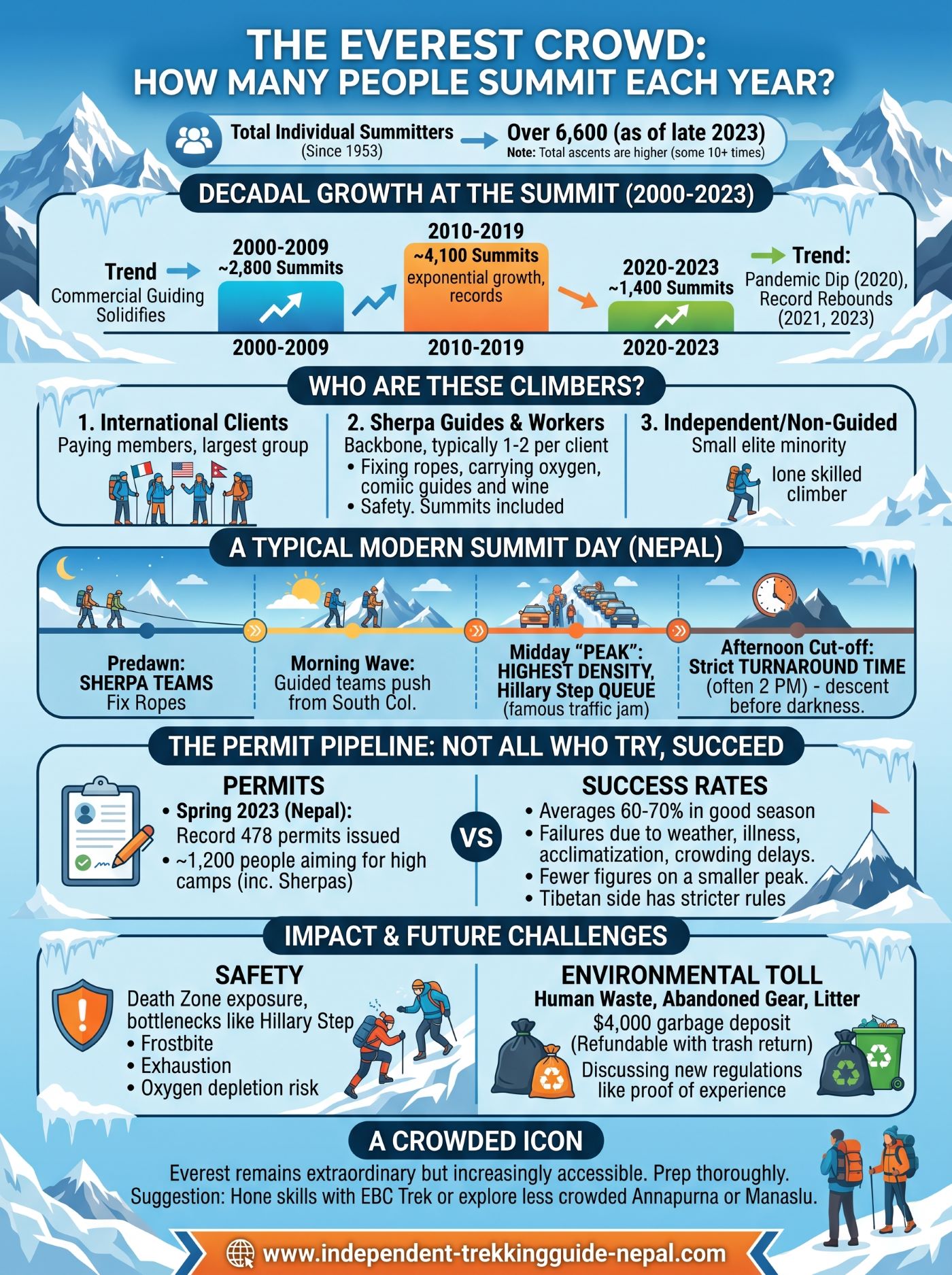
Decadal Growth at the Summit (2000-2023)
| Decade | Total Successful Summits (Approx.) | Notable Trend |
|---|---|---|
| 2000-2009 | ~2,800 | Commercial guiding solidifies. First “busy” seasons. |
| 2010-2019 | ~4,100 | Exponential growth. Records set & broken almost yearly. |
| 2020-2023 | ~1,400* | Pandemic dip (2020) followed by record rebounds (2021, 2023). |
Source: Compilation from Himalayan Database and Nepal Ministry of Tourism.
*(2020 saw only one permitted expedition from the China side)
The record-breaking year was 2023, with a staggering 667 successful summits recorded from the Nepal side alone. When including the Tibetan side, the total number of people who stood on the summit likely exceeded 700.
Interesting Fact: Due to the permits allowing climbers to summit from both Nepal and Tibet (in different years), the total number of successful ascents is higher than the total number of individual climbers. Some climbers have summited Everest over 10 times, mostly Sherpa guides.
The Breakdown: Who Are These Climbers?
The summit count isn’t just one number. It’s a composite of several key groups:
- International Clients: Paying members of guided expeditions. This is the largest and fastest-growing group.
- Sherpa Guides & High-Altitude Workers: The backbone of the industry. For every client, there are typically 1-2 Sherpas supporting the climb, fixing ropes, carrying oxygen, and ensuring safety. Their summit numbers are often included in the total.
- Independent/Non-Guided Climbers: A small, elite minority who climb without the support of commercial operators.

A Typical Modern Summit Day (Nepal Side)
On a prime weather day in May, the flow of people is structured:
- Predawn: Sherpa teams reach the summit first to secure fixed ropes.
- Morning Wave: The fastest and strongest guided teams begin their final push from the South Col.
- Midday “Peak”: The highest density of climbers converges on the Hillary Step and summit ridge, creating the famous “queue.”
- Afternoon Cut-off: Responsible teams enforce a strict turnaround time (often 2 PM) to ensure descent before darkness or oxygen depletion.
The Permit Pipeline: Not All Who Try, Succeed
The number of permits issued is the true indicator of pressure on the mountain. In the Spring 2023 season, Nepal issued a record 478 climbing permits for Everest. With an average support team of 1.5 Sherpas per client, this meant over 1,200 people were aiming for high camp.
Crucially, not everyone with a permit reaches the top. The success rate for all climbers (clients + Sherpas) averages 60-70% in a good season. Failure can be due to weather, illness, acclimatization issues, or the dangerous delays caused by crowding itself.
Interesting Fact: The Tibetan (North) side typically sees fewer climbers than the Nepalese (South) side. In recent years, China has enforced stricter regulations, including requiring climbers to have prior high-altitude experience, which acts as a filter.
The Impact & The Future: Beyond the Headlines
The soaring numbers have sparked essential debates about safety, ethics, and environmental sustainability.
- Safety: Crowding at key bottlenecks (like the Hillary Step) increases exposure time in the “Death Zone” (above 8,000m), raising the risk of frostbite, exhaustion, and depletion of supplemental oxygen.
- Environmental Toll: The mountain faces issues of human waste, abandoned gear, and litter. The Nepali government now requires a $4,000 garbage deposit per team, refundable if they bring down a mandated amount of trash.
- Regulation Changes: In response, authorities are discussing potential changes, such as requiring proof of high-altitude experience for climbers or further limiting the number of permits. The balance between accessibility, safety, and preservation is delicate.
For the most accurate and authoritative statistics, the Himalayan Database is the definitive record, while the Nepal Ministry of Tourism provides official permit data.
Conclusion: A Crowded Icon
The answer to “how many?” is a reflection of Everest’s dual reality: it remains an extraordinary, life-risking physical challenge, but one that has become increasingly accessible through commercial expedition logistics. The annual figure, now hovering around 700 summits, symbolizes human ambition, economic opportunity, and the urgent need for sustainable management.
The mountain is no longer a solitary wilderness experience but a global phenomenon. For those inspired by the challenge, thorough preparation—both physical and ethical—is more important than ever. Consider honing your skills on a premier Everest Base Camp Trek first, or exploring other magnificent but less crowded Nepal trekking packages in regions like Annapurna or Manaslu.
Whether the future holds stricter limits or a continued gentle rise in numbers, Everest will forever captivate the world’s imagination, one climber at a time.