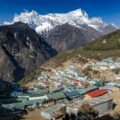
When we talk about places like the Everest South Base Camp in Nepal, or when we dream of multi-day treks through breathtaking landscapes, we are talking about one specific, dominant feature on our planet: the Himalayas.
The answer to the question, “What is the tallest mountain range in the world?” is definitive. It is the Himalayan mountain range. This majestic crescent of giants not only holds the record for the highest peaks on Earth but is also the spiritual and geographical heart of Asia, influencing climates, cultures, and the very concept of adventure.
This guide explores why the Himalayas are the tallest, what makes them so unique, and how they compare to other great ranges around the world.
The Himalayas: The Undisputed Champions
The Himalayas are the youngest and the tallest mountain range on the planet. Stretching in a massive arc for approximately 2,400 kilometers (1,500 miles) across Asia, they form a natural barrier between the Indian subcontinent and the Tibetan Plateau . This incredible range spans five nations: Nepal, India, Bhutan, China (Tibet), and Pakistan .
But what truly sets them apart is their staggering altitude. The Himalayas are home to the world’s highest peaks, including all 14 of the planet’s “eight-thousanders”—mountains that rise above 8,000 meters (26,247 feet). They are the only place on Earth where you can stand at the foot of a mountain that literally pierces the jet stream.
The Crown Jewel: Mount Everest
At the heart of this range sits its crowning glory: Mount Everest, known in Nepal as Sagarmatha (Forehead of the Sky) and in Tibet as Chomolungma (Mother Goddess of the World). Its summit stands at a staggering 8,848.86 meters (29,031.7 feet) above sea level , a height officially recognized by both Nepal and China in a joint announcement in 2020.
Everest is not just a mountain; it is the ultimate symbol of exploration and human endurance. As we’ve discussed, the journey to its South Base Camp in Nepal is the quintessential Himalayan trek, drawing thousands of adventurers each year who want to walk in the shadow of the world’s highest point.
What Makes a Mountain Range “Tall”?
It’s important to distinguish between a mountain range’s height and its sheer size. While ranges like the Andes are longer and ranges like the Karakoram have some of the most concentrated high peaks, the Himalayas win the title of “tallest” because they possess the highest average elevation and contain the greatest number of extreme high-altitude peaks. Think of it this way: if you measured the top 100 tallest mountains in the world, the vast majority would be in the Himalayas.
The Mighty Neighbors: Other Great Ranges
While the Himalayas are the tallest, they are part of a greater complex of mountain ranges. To understand their dominance, it helps to look at their neighbors.

The Karakoram Range
Often mentioned in the same breath as the Himalayas, the Karakoram range lies to the northwest, stretching across the borders of Pakistan, India, and China. It is home to some of the most dramatic and dangerous mountains on Earth, including the world’s second-highest peak, K2 (8,611m / 28,251 ft) . While the Karakoram is incredibly high and contains more glacial ice than any other range outside the poles, it is smaller in overall extent than the Himalayas .
The Hindu Kush
Extending westward from the Pamir Knot, the Hindu Kush runs through Afghanistan and into northern Pakistan. Its highest peak, Tirich Mir, stands at 7,708 meters (25,289 feet). While formidable, it does not reach the extreme altitudes of its eastern neighbors .
The Andes
If we look beyond the “Himalayan-Karakoram-Hindu Kush” region, the next contender is the Andes in South America. The Andes are the longest continental mountain range in the world, stretching over 7,000 kilometers (4,300 miles) along the western coast . However, their highest peak, Aconcagua, is 6,961 meters (22,841 feet) . This is over 1,800 meters (6,000 feet) shorter than Everest, placing the Andes in a clear second place for height.
How Were the Himalayas Formed?
The story of the Himalayas is a dramatic tale of geological violence. Millions of years ago, the land that is now India was a large island, floating slowly northward towards the vast Eurasian continent. Around 40 to 50 million years ago, the Indian Plate collided with the Eurasian Plate .
But instead of one sliding under the other, the two continental plates had a head-on collision. The force was so immense that the edge of the Eurasian continent began to crumple, fold, and rise up. This process, which is still happening today, pushed the ancient seabed of the Tethys Ocean to form the highest mountains on Earth. The Himalayas are still growing at a rate of about 5 millimeters per year as the Indian Plate continues to push northward .
Why They Matter: More Than Just Height
The Himalayas are not just a spectacular sight; they are a fundamental force of nature.
Climate Regulators: They act as a colossal weather barrier, blocking cold, dry winds from Tibet from reaching the subcontinent and forcing the monsoon winds to release their rain, which feeds the rivers and agriculture of South Asia .
The Water Towers of Asia: The range is the source of some of the world’s mightiest river systems, including the Indus, Ganges, and Brahmaputra (known as Yarlung Tsangpo in Tibet). The permanent snow and glaciers of the Himalayas feed these rivers, providing water for over 1.3 billion people downstream .
Biodiversity Hotspot: The dramatic variation in altitude, from tropical foothills to frozen peaks, creates a stunning array of ecosystems. The Himalayas are home to incredibly diverse wildlife, including the elusive snow leopard, the red panda, the Himalayan tahr, and the massive yak .
Cultural and Spiritual Heart: For millennia, the Himalayas have been a sacred landscape. They are the abode of gods in Hindu mythology, the home of enlightened beings in Buddhism, and a destination for pilgrims and seekers from around the world. The very name “Himalaya” comes from Sanskrit: Hima (snow) and Alaya (abode) – the “Abode of Snow” .
Conclusion
So, when you look at a map and dream of trekking to Everest Base Camp, or when you read about the challenges of climbing K2, you are engaging with the tallest, most awe-inspiring mountain range on our planet. The Himalayas are not just a geographical feature; they are a living, growing monument to the powerful forces of our Earth and a place where the human spirit goes to be challenged and inspired. They truly are the “Roof of the World.”