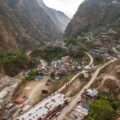
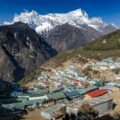
There is nowhere else on Earth like the Himalayas. This is the planet’s highest mountain range — a colossal wall of rock and ice holding all ten of the world’s highest peaks, feeding rivers that sustain nearly two billion people, and sheltering some of the rarest wildlife and oldest living cultures anywhere.
Whether you’re researching for a school project, dreaming about a first trek, or finally planning that trip to Nepal, this guide answers the big questions: where is the Himalayas located, what makes the Himalayas and Everest so special, and which animals in Himalayas you might actually spot on the trail.

Where Is the Himalayas Located?
The Himalayas stretch in a great arc of roughly 2,400 kilometers (1,500 miles) across South Asia, spanning five countries: Nepal, India, Bhutan, China (Tibet), and Pakistan. The range runs from the Indus River valley in the northwest to the Brahmaputra valley in the east, separating the plains of the Indian subcontinent from the Tibetan Plateau.
The word itself comes from Sanskrit — hima (snow) and alaya (abode): “the abode of snow.”
Geologically speaking, the Himalayas are babies. They began forming around 50 million years ago when the Indian tectonic plate collided with the Eurasian plate — a collision that is still happening today. The Indian plate continues to push northward, which means the Himalayas are still rising by several millimeters every year. Earthquakes, dramatic gorges, and those impossibly steep valleys are all products of this ongoing geological drama.
The range is also Asia’s water tower. Glaciers and snowmelt here feed the Ganges, Indus, Brahmaputra, and countless other rivers, supplying water to nearly a fifth of humanity downstream.
Nepal sits at the heart of it all. Of the fourteen mountains on Earth above 8,000 meters, eight are in Nepal or on its borders — which is why the country has become the world’s trekking capital.

The Himalayas and Everest: Home of the World’s Highest Peaks
You can’t talk about the Himalayas and Everest separately — the range and its most famous summit are inseparable in most people’s minds. Mount Everest, known as Sagarmatha in Nepali and Chomolungma in Tibetan, stands at 8,849 meters (29,032 feet), the highest point on the planet. It sits on the border between Nepal and Tibet, inside Nepal’s Sagarmatha National Park, a UNESCO World Heritage Site.
But Everest has plenty of company. The Himalayas contain all ten of the world’s highest mountains, including:
| Peak | Height | Location |
|---|---|---|
| Everest | 8,849 m | Nepal / Tibet |
| Kangchenjunga | 8,586 m | Nepal / India |
| Lhotse | 8,516 m | Nepal / Tibet |
| Makalu | 8,485 m | Nepal / Tibet |
| Cho Oyu | 8,188 m | Nepal / Tibet |
| Dhaulagiri | 8,167 m | Nepal |
| Manaslu | 8,163 m | Nepal |
| Annapurna I | 8,091 m | Nepal |
Here’s the part many people don’t realize: you don’t need to be a mountaineer to stand among these giants. Every year, tens of thousands of ordinary trekkers with reasonable fitness walk the trail to the foot of the world’s highest mountain. Our Everest Base Camp Trek follows the classic route through Sherpa villages and high mountain monasteries to Base Camp at 5,364 meters — no ropes or crampons required, just good boots and a couple of weeks.

Animals in Himalayas: Wildlife of the High Mountains
The animals in Himalayas are as extraordinary as the landscape — evolution’s answer to thin air, brutal winters, and vertical terrain. Here’s who lives up here:
Snow leopard. The ghost of the mountains. Perhaps the most elusive big cat on Earth, the snow leopard roams the high slopes between 3,000 and 5,000 meters. Fewer than 7,000 are thought to survive in the wild, and organizations like the World Wildlife Fund run active conservation programs across the Himalayan region. Seeing one is a once-in-a-lifetime event — but their pugmarks in fresh snow are spotted by trekkers more often than you’d think.
Red panda. This rust-colored, cat-sized bamboo-eater lives in the temperate forests of the eastern Himalayas, including Nepal’s Langtang and Kangchenjunga regions.
Himalayan tahr and blue sheep (bharal). These sure-footed wild goats and sheep graze impossibly steep cliffs — and are the snow leopard’s main prey. Tahr sightings are common on the Annapurna and Everest trails.
Yak. The shaggy workhorse of the high Himalaya. Domesticated yaks (and their crossbreeds, called dzopkyo) carry loads on every major trekking route above 3,000 meters. You’ll share the trail with plenty of them.
Himalayan monal (danphe). Nepal’s national bird looks like it was painted by someone showing off — iridescent blue, green, copper, and purple. Watch for them in forest clearings between 2,500 and 4,500 meters.
Musk deer, Himalayan black bear, langur monkeys, and over 900 bird species round out one of the richest mountain ecosystems in the world.

The best wildlife spotting comes on quieter trails at forested elevations — one of many reasons treks through the Annapurna region’s rhododendron forests are so rewarding in spring.
People of the Himalayas
The mountains aren’t wilderness alone — they’re home. The Sherpa people of the Everest region, famed worldwide for their mountaineering strength, have lived in the high Khumbu for centuries. The Annapurna region is home to Gurung and Magar communities, whose stone villages terrace the hillsides. Tibetan Buddhism and Hinduism intertwine throughout the range: you’ll pass mani walls carved with prayers, spinning prayer wheels, fluttering prayer flags on every pass, and monasteries that have watched over these valleys for hundreds of years.
This living culture is what turns a Himalayan trek from a hike into something closer to a pilgrimage. Nights are spent in family-run teahouses, meals are shared over dal bhat, and the trail itself is a village-to-village artery that locals have walked for generations.

Experiencing the Himalayas for Yourself
Reading about the Himalayas is one thing. Standing beneath an 8,000-meter wall of ice at sunrise is another entirely. The good news: there’s a trek for every fitness level and timeframe.
Short on time or new to trekking? The Ghorepani Poon Hill Trek packs a classic Himalayan sunrise — a panorama of Dhaulagiri and the entire Annapurna range — into just 4–5 days at moderate altitudes. It’s the perfect first taste of the Himalayas.
Want to walk into the heart of the range? The Annapurna Base Camp Trek leads through rhododendron forest and Gurung villages into a natural amphitheater ringed by 7,000- and 8,000-meter peaks — one of the most dramatic settings on the planet, reachable in about 10 days.
Chasing the big one? The Everest Base Camp Trek remains the world’s most iconic walk, and for good reason.
Spring (March–May) and autumn (October–November) offer the clearest skies and most stable weather across the whole range.
FAQs
Where is the Himalayas located? The Himalayas span five countries across South Asia — Nepal, India, Bhutan, China (Tibet), and Pakistan — stretching about 2,400 km from the Indus valley in the west to the Brahmaputra valley in the east.
Is Mount Everest part of the Himalayas? Yes. Everest (8,849 m) is the highest peak of the Himalayas and of the world, located on the Nepal–Tibet border within Sagarmatha National Park.
What animals live in the Himalayas? Iconic Himalayan wildlife includes the snow leopard, red panda, Himalayan tahr, blue sheep, musk deer, yak, Himalayan black bear, and the colorful Himalayan monal, Nepal’s national bird.
Can beginners trek in the Himalayas? Absolutely. Routes like Ghorepani Poon Hill require only moderate fitness and stay below serious altitude, while classic treks like Annapurna and Everest Base Camp are achievable for most people who can hike 5–6 hours a day.
Are the Himalayas still growing? Yes — the Indian tectonic plate is still pushing into Asia, lifting the range by several millimeters each year.