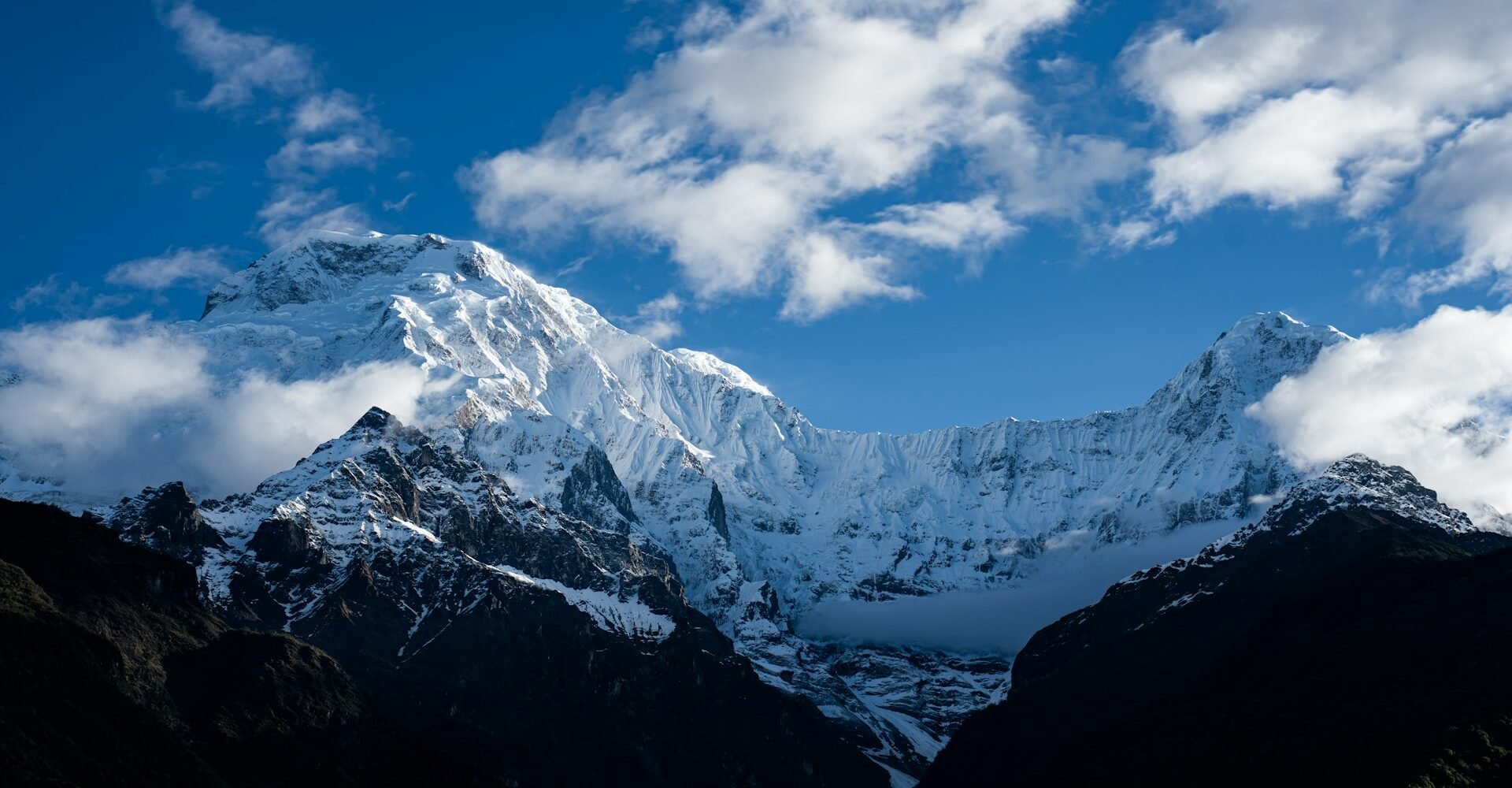
Few places on earth fire the imagination of trekkers quite like the Annapurna region of central Nepal. Spread across a wilderness larger than some European countries, the Annapurna massif encompasses soaring 8,000-metre summits, subtropical gorges, high alpine deserts, and a mosaic of Gurung, Thakali, and Magar villages that have changed little in centuries. Whether you walk for seven days or a full month, the Annapurna trail rewards you at every step.
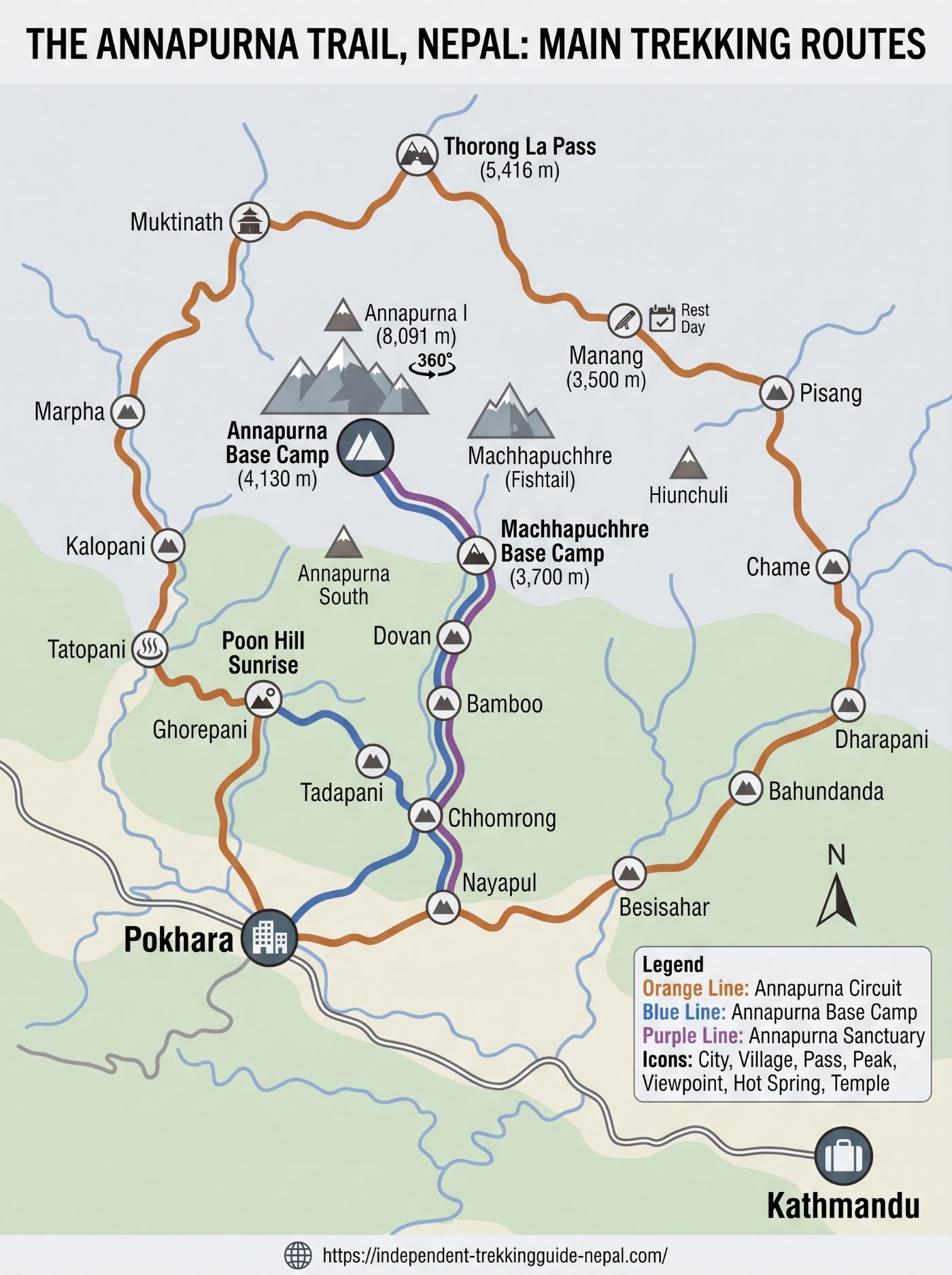
Pokhara, the lakeside city at the foothills, serves as the gateway — a three-hour drive from Kathmandu, or a short flight. From there, the trails fan out into three main routes that together form the backbone of Nepal’s trekking industry: the Annapurna Circuit, the Annapurna Base Camp trek, and the Annapurna Sanctuary trekking route into the glacial bowl beneath the south face.
Why the Annapurna Region?
The Annapurna Conservation Area — Nepal’s largest protected area at 7,629 sq km — is home to over 1,200 plant species, 105 mammal species, and 518 bird species. Snow leopards, red pandas, and Himalayan thar roam its upper reaches. Lower valleys burst with rhododendron forests that turn the hillsides crimson and pink every spring. It’s also one of the most culturally dense corridors in the Himalayas.
“The Annapurna trail doesn’t just take you through landscapes — it takes you through cultures, climates, and centuries, all in a single journey.”

Rhododendron forests blaze with colour on the trail to Ghorepani — best seen March through May.
The Three Main Routes
Choosing the right Annapurna trail depends on your time, fitness, and what you want to see. Here is an at-a-glance comparison of the three classic routes.
| Route | Duration | Max Altitude | Difficulty | Highlight |
|---|---|---|---|---|
| Annapurna Circuit | 14–21 days | 5,416 m (Thorong La) | Strenuous | Thorong La Pass, Mustang villages |
| Annapurna Base Camp | 10–14 days | 4,130 m (ABC) | Moderate | 360° view of Annapurna I & Machhapuchhre |
| Annapurna Sanctuary | 10–12 days | 4,130 m | Moderate | Glacial amphitheatre, ice seracs, sunrise views |
The Annapurna Circuit — The Grand Loop
The Annapurna Circuit is one of the world’s great long-distance treks. Circumnavigating the entire Annapurna massif, it takes trekkers through an extraordinary range of terrain — from the subtropical Modi Khola valley through pine-forested ridges, across the arid trans-Himalayan plateau of Mustang, and finally over the Thorong La Pass at 5,416 metres before descending into the pilgrimage city of Muktinath.
The Thorong La Pass (5,416 m) is the crown of the Annapurna Circuit — most trekkers cross at dawn to beat the afternoon winds.
Sample Circuit Itinerary
- Day 1–2: Pokhara to Besisahar to Bhulbhule (820 m)
- Day 3–5: Bahundanda – Chamje – Dharapani – Chame (2,710 m)
- Day 6–7: Pisang – Manang (3,500 m) — acclimatisation day
- Day 8: Manang to High Camp (4,850 m)
- Day 9: Thorong La Pass crossing – Muktinath (3,760 m)
- Day 10–12: Marpha – Kalopani – Tatopani (natural hot springs)
- Day 13–14: Ghorepani – Poon Hill sunrise – Nayapul – Pokhara
Insider tip
Spend a full rest day in Manang (3,500 m) before attempting Thorong La. Visit the Himalayan Rescue Association altitude sickness clinic — it’s free and could save your life. Most altitude-related emergencies on the Circuit happen to trekkers who skip acclimatisation.
Annapurna Base Camp — Into the Sanctuary
The Annapurna Base Camp trek leads you through a narrow gorge flanked by Hiunchuli and Machhapuchhre (Fishtail) — the sacred peak that has never been officially summited — and into the Annapurna Sanctuary: a glacial amphitheatre ringed by thirteen peaks above 6,000 metres. Annapurna I (8,091 m), the world’s tenth-highest mountain, towers above the camp.


Machhapuchhre (Fishtail) and the Annapurna giants at sunrise from Base Camp — arguably Nepal’s most spectacular mountain panorama.
The Annapurna Sanctuary trekking route follows the same corridor and reaches the same amphitheatre, but emphasises the glacial and wilderness character of the upper sanctuary. It is one of Nepal’s most emotionally powerful high-altitude experiences — arriving at base camp at 4,130 metres, surrounded on all sides by Himalayan giants, with no civilisation for miles in any direction.
Key Stops on the ABC Route
- Nayapul / Tikhedhunga — trail start, terraced rice fields
- Ghorepani — famous Poon Hill sunrise viewpoint (3,210 m)
- Tadapani & Chhomrong — Gurung village life, cardamom gardens
- Bamboo & Dovan — deep gorge, bamboo groves, waterfalls
- Machhapuchhre Base Camp (3,700 m) — first full Himalayan panorama
- Annapurna Base Camp (4,130 m) — 360° view of thirteen summits
Best Time to Trek the Annapurna Trail
Nepal has two primary trekking windows, each with distinct character. Your choice of season shapes not just the weather but the entire feel of the journey.
| Season | Months | Weather | Crowd level | Suitability |
|---|---|---|---|---|
| Autumn (peak) | Oct – Nov | Clear, crisp, dry | High | ★★★★★ All routes |
| Spring | Mar – May | Warm, some haze, rhododendron bloom | Medium–High | ★★★★☆ All routes |
| Winter | Dec – Feb | Cold, clear, Thorong La may close | Low | ★★★☆☆ ABC only |
| Monsoon | Jun – Sep | Heavy rain, leeches, landslide risk | Very low | ★★☆☆☆ Not recommended |

Autumn brings the clearest skies and most reliable mountain views across the entire Annapurna region.
Permits and Practicalities
All trekkers in the Annapurna Conservation Area require two documents before setting foot on the trail. Both are obtainable in Kathmandu or Pokhara.
| Permit | Cost (approx.) | Where to get it |
|---|---|---|
| ACAP (Annapurna Conservation Area Permit) | NPR 3,000 (~USD 23) | Nepal Tourism Board, Kathmandu / Pokhara |
| TIMS (Trekkers’ Information Management System) | NPR 2,000 (~USD 15) | Nepal Tourism Board or trekking agency |
Essential Packing List
- Layering system: moisture-wicking base, fleece mid-layer, waterproof outer shell
- Down jacket (essential above 3,500 m, even in October)
- Trekking poles — invaluable on steep descents
- Broken-in waterproof hiking boots with ankle support
- Sleeping bag rated to at least -10°C for high camps
- Headlamp with spare batteries for early Thorong La starts
- Water purification tablets or a UV pen (Steripen)
- Altitude sickness medication (Diamox — consult your doctor)
- Sunscreen SPF 50+ and UV-protection sunglasses
- Trekking permits, passport copies, travel insurance documents
Hiring a guide or porter
Nepal’s trekking industry directly supports thousands of mountain communities. Hiring a licensed local guide through a registered agency not only increases your safety — guides know the trails, weather patterns, and lodge conditions intimately — it also ensures your spending benefits Nepali families rather than external platforms. A good guide also doubles as a cultural interpreter, opening doors to village life, monastery visits, and conversations you’d never have alone. The Nepal Tourism Board maintains a register of certified guides.
Flora, Fauna and Cultural Highlights
The Annapurna trail is as much an ecological journey as a physical one. The lower valleys support dense subtropical forests of rhododendron, oak, and bamboo — prime habitat for red pandas. Higher up, the vegetation shifts to juniper and pine scrub, and above the tree line, Himalayan tahr, blue sheep (bharal), and occasionally snow leopards inhabit the rocky slopes.

Gurung villages like Chhomrong and Ghandruk offer trekkers a living window into traditional Himalayan culture — stone-paved lanes, carved doorways, and warm teahouse hospitality.
Cultural encounters along the trail
- Manang: A high-altitude Tibetan-influenced trading town with a famous monastery and a yak cheese shop beloved by trekkers
- Muktinath: One of the most sacred Hindu and Buddhist pilgrimage sites in Asia — flaming natural gas vents and a 108-spout water temple
- Marpha: The “apple capital of Nepal” — try fresh apple brandy and apple pie at tiny family-run bakeries
- Ghorepani: A traditional Magar settlement and launchpad for the legendary Poon Hill sunrise, where up to 14 Himalayan peaks are visible simultaneously
Useful External Resources
- Nepal Tourism Board — official permits, safety advisories, and licensed guide registry
- NTNC Annapurna Conservation Area Project — conservation news and trail conditions
- Trekking Agencies’ Association of Nepal (TAAN) — find registered trekking operators
- High Altitude Medicine & Physiology — acclimatisation guidelines and AMS prevention
“The mountains of the Annapurna region do not merely reward effort — they transform the people who walk among them.”
Plan Your Annapurna Adventure
Whether you choose the epic circumnavigation of the Annapurna Circuit trek, the intimate pilgrimage to Annapurna Base Camp, or the raw wilderness of the Annapurna Sanctuary trekking route — this region will exceed every expectation. The Himalayas have a way of humbling and uplifting in equal measure, and the Annapurna trails do this better than almost anywhere on earth.
Start planning early, respect the mountain environment, hire local expertise, and go slowly. Nepal’s greatest gift to the trekker is not the summit view — it is everything you learn about yourself on the path to reach it.