There is something deeply primal about the high mountains of the world. They are nature’s cathedrals—silent, ancient, and utterly indifferent to human ambition. Yet we keep climbing them. Not because they are easy, but precisely because they are hard. This guide takes you through the most significant tallest peaks in the world, from the mighty Himalayas to the highest point on every continent.
“It’s not the mountain we conquer, but ourselves.” — Sir Edmund Hillary
What Defines the High Mountains of the World?
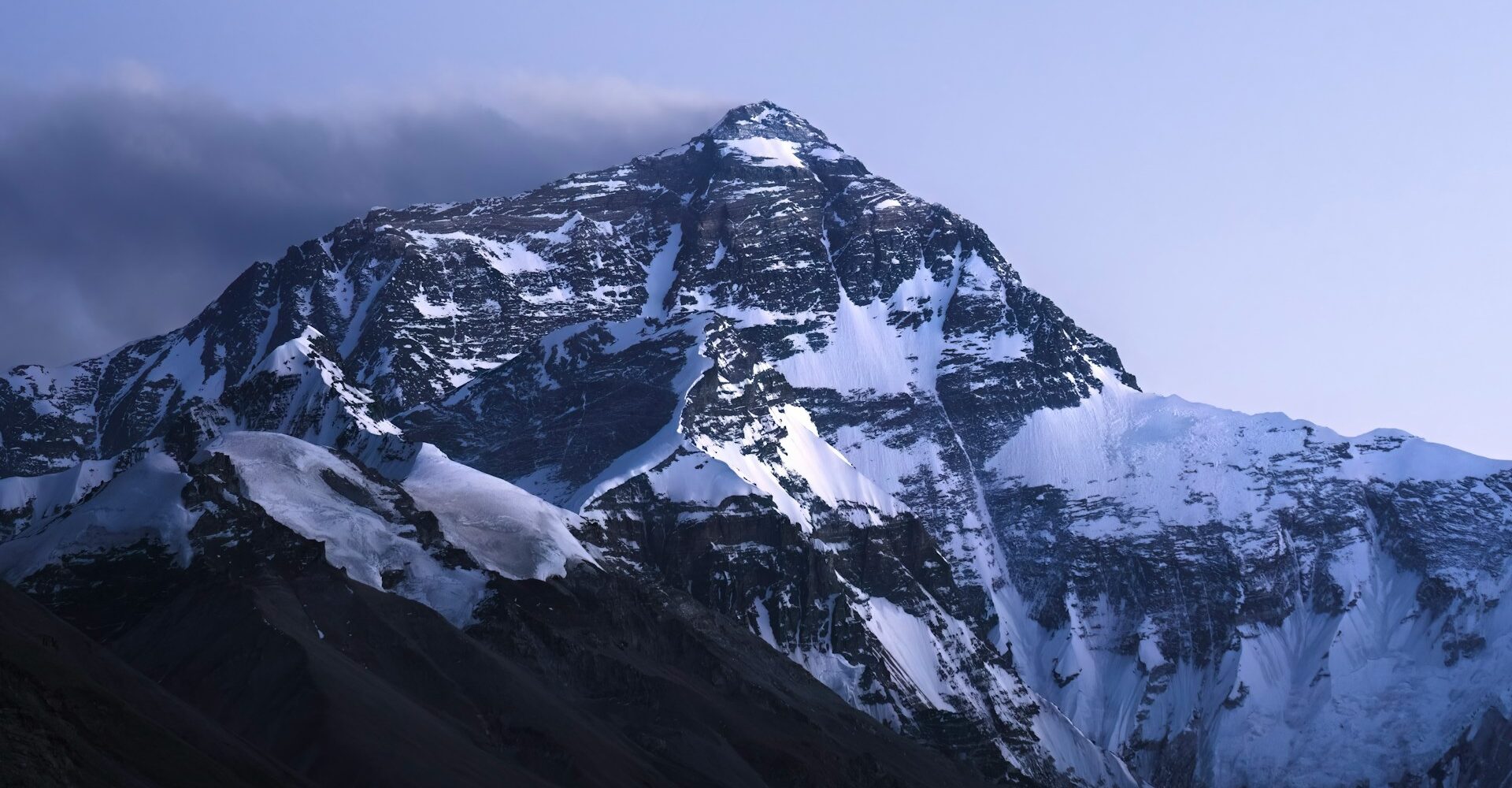
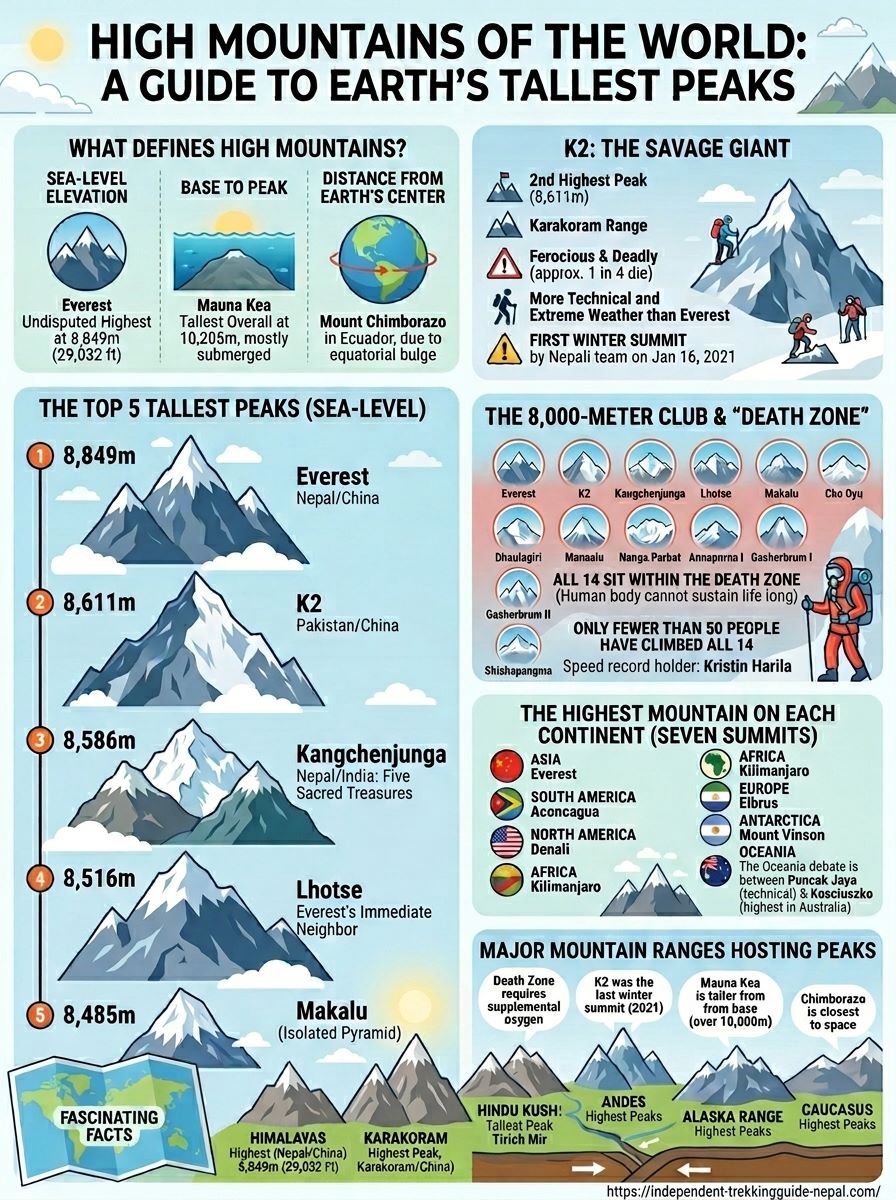
Before we rank the giants, a crucial distinction must be made. When we talk about the tallest peaks in the world, we typically mean elevation above sea level. By this measure, Mount Everest is the undisputed highest peak in world geography at 8,849 meters (29,032 feet) . However, if measured from base to peak—including what lies beneath the ocean—Mauna Kea in Hawaii is actually the tallest, rising a staggering 10,205 meters from the ocean floor, with 6,000 meters sitting below sea level .
Then there is the question of distance from Earth’s center. Due to the equatorial bulge, Mount Chimborazo in Ecuador holds this distinction . But for mountaineers and most geography lovers, sea-level elevation remains the gold standard.
The Top 5 Tallest Peaks in the World

A glorious view of Mount Everest at the sunset
Almost all of the truly high mountains of the world are concentrated in the Himalaya and Karakoram ranges of Asia. Of the 14 peaks exceeding 8,000 meters, 10 lie in the Himalayas and 4 in the Karakoram .
| Rank | Mountain | Elevation | Location | Key Fact |
|---|---|---|---|---|
| 1 | Mount Everest | 8,849m (29,032 ft) | Nepal / China | The highest peak in world; known as Sagarmatha in Nepal and Chomolungma in Tibet |
| 2 | K2 | 8,611m (28,251 ft) | Pakistan / China | The 2nd highest peak in world; also called Mount Godwin Austen |
| 3 | Kangchenjunga | 8,586m (28,169 ft) | Nepal / India | Guarded by five sacred treasures; first climbed in 1955 |
| 4 | Lhotse | 8,516m (27,940 ft) | Nepal / China | Everest’s immediate neighbor, sharing a saddle with the king |
| 5 | Makalu | 8,485m (27,838 ft) | Nepal / China | A striking isolated pyramid shape |
The Second Highest Mountain in the World: K2, The Savage Giant
While Everest basks in glory, the second highest mountain in the world commands a darker kind of respect. K2, straddling the Pakistan-China border in the Karakoram range, rises 8,611 meters . It was designated “K2” in 1856 simply because it was the second peak measured in the Karakoram survey. Later, it was formally named Mount Godwin Austen after a British surveyor .
Among mountaineers, K2 is legendary—not just for being the 2nd highest peak in world rankings, but for its ferocity. The statistics tell a grim story: approximately one climber dies for every four who reach its summit. The mountain is steeper, more technical, and plagued by far more unpredictable weather than Everest.
A historic moment arrived on January 16, 2021, when a team of Nepali climbers became the first to summit K2 in winter—conquering the last of the 8,000-meter peaks to be climbed in the harshest season.
“The mountains have rules. They are harsh rules, but they are there, and if you keep to them you are safe. A mountain is not like men. A mountain is sincere.” — Walter Bonatti
The 8,000-Meter Club: The Full List of the High Mountains of the World
All 14 of the world’s peaks above 8,000 meters sit within the “Death Zone”—an altitude where the human body cannot sustain itself for long . Climbing all 14 is considered one of mountaineering’s ultimate achievements; fewer than 50 people have ever done it .
The complete list includes Everest, K2, Kangchenjunga, Lhotse, Makalu, Cho Oyu, Dhaulagiri, Manaslu, Nanga Parbat, Annapurna I, Gasherbrum I, Broad Peak, Gasherbrum II, and Shishapangma .
Norwegian Kristin Harila holds the speed record for climbing all 14, completing the feat in just 92 days in 2023, breaking Nirmal Purja’s previous record .
The Highest Mountain on Each Continent: The Seven Summits
Not everyone aspires to the Death Zone. For many adventurers, the “Seven Summits”—the highest mountain on each continent—represents a more achievable, though still formidable, challenge. The concept was popularized by Richard Bass, who became the first to climb all seven in 1985 .
Here is the most commonly accepted list :
| Continent | Peak | Elevation | Country | Notes |
|---|---|---|---|---|
| Asia | Mount Everest | 8,849m | Nepal / China | The highest peak in world and ultimate Seven Summits crown |
| South America | Aconcagua | 6,961m | Argentina | Highest peak outside Asia; the “Stone Sentinel” |
| North America | Denali | 6,190m | USA (Alaska) | Known for brutal Arctic weather and severe latitude sickness |
| Africa | Kilimanjaro | 5,895m | Tanzania | A free-standing volcano; the easiest of the Seven Summits technically |
| Europe | Mount Elbrus | 5,642m | Russia | A dormant volcano in the Caucasus; some argue Mont Blanc should hold this title |
| Antarctica | Mount Vinson | 4,892m | Antarctica | The most remote and expensive to access |
| Oceania | Puncak Jaya | 4,884m | Indonesia | Also called Carstensz Pyramid; technical rock climbing in dense jungle |
The Oceania Debate
The “highest mountain on each continent” question gets complicated when we reach Oceania. If you define the Australian continent strictly by mainland Australia, Mount Kosciuszko (2,228m) takes the title—a gentle four-hour walk from the nearest car park . However, if you include the broader Sahul continental shelf, Puncak Jaya in Indonesia’s Papua province is the true highest point at 4,884 meters. The Messner list uses Puncak Jaya; the Bass list uses Kosciuszko .
Major Mountain Ranges That Host the High Mountains of the World
The world’s highest peaks are not randomly scattered—they cluster in specific ranges where tectonic plates collide :
| Mountain Range | Countries | Highest Peak | Elevation |
|---|---|---|---|
| Himalayas | Nepal, India, Bhutan, China, Pakistan | Mount Everest | 8,849m |
| Karakoram | Pakistan, India, China | K2 | 8,611m |
| Hindu Kush | Afghanistan, Pakistan | Tirich Mir | 7,708m |
| Andes | Argentina, Chile, Peru, Bolivia | Aconcagua | 6,961m |
| Alaska Range | USA | Denali | 6,190m |
| Caucasus | Russia, Georgia | Mount Elbrus | 5,642m |
The Himalayas, Karakoram, and Hindu Kush together form the greatest concentration of the tallest peaks in the world—a region sometimes called the “Third Pole” due to its vast ice reserves .
Fascinating Facts About the High Mountains of the World
- Everest is still growing. Tectonic plate movement pushes the summit approximately 4mm higher every year .
- All 8,000m peaks are in the Death Zone. Above 8,000 meters, oxygen levels cannot sustain human life. Supplemental oxygen becomes essential for most climbers .
- K2 was the last 8,000m peak to be climbed in winter. This feat was only achieved on January 16, 2021, by a Nepali team.
- Mauna Kea dwarfs Everest when measured from base to summit—it’s over 10,000 meters tall, with most of its mass underwater .
- Chimborazo is the closest point to space. Due to Earth’s equatorial bulge, this Ecuadorian peak is literally the closest point on Earth to the stars .
- Manaslu and Cho Oyu are considered the “easiest” 8,000m climbs, though “easy” is a relative term at these altitudes .
Frequently Asked Questions
Q: What is the highest peak in the world?
A: Mount Everest, located on the Nepal-China border in the Himalayas, is the highest peak in world at 8,849 meters (29,032 feet) above sea level .
Q: Which is the second highest mountain in the world?
A: K2 (also called Mount Godwin Austen), at 8,611 meters, is the 2nd highest peak in world. It sits in the Karakoram range between Pakistan and China .
Q: What is the highest mountain on each continent?
A: Asia: Everest (8,849m), South America: Aconcagua (6,961m), North America: Denali (6,190m), Africa: Kilimanjaro (5,895m), Europe: Mount Elbrus (5,642m), Antarctica: Mount Vinson (4,892m), Oceania: Puncak Jaya (4,884m) or Mount Kosciuszko (2,228m) .
Q: What are the easiest 8,000-meter peaks to climb?
A: Manaslu (8,163m) and Cho Oyu (8,201m) are generally considered less technical and safer options among the 14 peaks above 8,000 meters .
Q: Are the high mountains of the world still growing?
A: Yes. The Himalayan range continues to rise as the Indian tectonic plate pushes into the Eurasian plate. Everest grows about 4mm annually .
Conclusion
The tallest peaks in the world are more than statistics in a geography textbook. They are the ultimate test of human spirit—reminders that our planet is alive, dynamic, and capable of creating wonders that humble us. Whether you dream of standing atop the highest peak in world or simply want to gaze upon the high mountains of the world from a comfortable teahouse in Nepal, these giants call to something deep within us all.
“Climbing is not a battle with the elements, nor against the law of gravity. It’s a battle against oneself.” — Walter Bonatti
Ready to explore the high mountains of the world? Check out our guide to winter trekking in Nepal for an adventure among the tallest peaks on Earth.